In Paris, customer service is almost as elusive as Big Foot. I am not the first person to write about this fact, but now I can write about it from the perspective of my own numerous experiences. The ubiquitous principle in the States, "The customer is always right", is the exact opposite in France. As a Parisian consumer, one becomes accustomed to being made to feel small, insignificant, bothersome, and/or just plain wrong.
Take for example, restaurants (the ones without those little Michelin stars). Waiters do not work for tips, therefore, their attitude of annoyance at even our tiniest and most basic request, such as, "Le addition (the bill), si vous plait?" will not affect their take-home pay. Soren and I ate lunch with friends recently at a popular establishment frequented by Parisians. This place, we were told, serves a fabulous Magret du Canard. They must have had to go out to the country after our order to slash the ducks' throats and pluck their feathers before bringing them back to the restaurant for cooking because an hour after ordering, still no Magret du Canard at our table. Our friend, who speaks better French than Soren, got the attention of our busy waiter and inquired about our lengthy wait. In response, our waiter shrugged his shoulders, looked miffed, and basically retorted something hautily French along the lines of, "What can I say, it's taking long because it's taking long." Fifteen minutes later, our meals arrived without any acknowledgment or apology. And no free drinks or dessert as compensation either! Alas, this is the French way.
It is also the French way to charge customers money when we call the customer service department of say, the electric company, who charges us twenty cents a minute on top of the initial 1.20 euros we're charged to make the call in the first place. Is this backwards or what? The obvious question is what incentive do these companies have to provide efficient service in the first place when they make more money if they are anything but?
Last month, while browsing in a shoe store, I noticed a style in the window display that I wanted to try. I knew better than to touch it (see previous post "Shopping: Je Ne Comprend Pas"). Upon hearing my request, the clerk tells me that shoe is unavailable in my size. However, I see that the one on display is, in fact, my size. I indicate this knowledge to her and she flatly refused to allow me to try it. I am so perplexed by this logic; obviously, the store will make money from the sale of those shoes, right? Aren't businesses in the business of making money? I am beginning to think French businesses are in the business of pissing off customers by not giving them what they want.
Case in point: the grocery store. I have witnessed shoppers present coupons only to be lectured by the cashier and eventually, the manager, about how and why the coupon cannot and will not be honored. I am fairly certain it's not a simple matter of an expired coupon date because the conversations that I have witnessed between employees and customers have lasted too long and are way too contentious. Of course, I always unwittingly wind up in line behind these coupon-bearing customers. My best guess is that the customers have presented their coupons midway through the check-out process and the store's antiquated computer system is incapable of processing a coupon for an item that has already been scanned. I imagine that updating their computer system would obsolete the long-standing rules and procedures that managers and employees believe to be the cornerstone of their (unfriendly and inefficient) business model.
Speaking of antiquated, we take our dry cleaning to a 'presse' that does not have a modern computer system logging their customer's transactions by their name, address, and/or phone number. We had not given any thought to their outmoded system until one day, Soren arrived at the presse to pick up his dress shirts. He came back to the apartment empty-handed, explaining that he did not have his claim ticket with him upon pick-up. "Can't they look you up in their computer," I asked? Uh, no. See, it works like this- no ticket, no shirts.
The lady at the presse told Soren that he needs to go home and find his ticket. Soren unsuccessfully searched through every pocket, shopping bag, and trash can hoping to find this darned ticket. The only hope he had now was that the written description (in French) of his shirts that he left with the presse lady along with his mobile number would result in a phone call from her explaining that she had found his shirts.
The next day we passed by the presse while out running errands and Soren decided to give it another try because he noticed that a different lady was behind the counter. This lady clearly did not want to be bothered because she coldly and dismissively told Soren, "Vous venez demain à 13:00h." Does she know for a fact that his shirts are going to decide to appear exactly at 1:00 p.m. tomorrow or is there actually going to be an employee present at that time who will actually help to find them?
The next day's agenda was completely structured around this 1:00 p.m. call-time at the presse. Cold Lady was there again, and she was no warmer today than yesterday- in fact, she pulled a diva maneuver on me when I attempted to film Soren speaking French to the other nicer presse lady. Cold Lady put her hand in front of my little Flip video camera and told me not to film. I explained, in French, that I was filming only my husband. The other nice presse lady was smiling at me, but Cold Lady would have none of it. So I stopped filming. It is Cold Lady's voice you hear at the end of this short clip, telling me not to film:
Nice Lady explained that we needed to walk next door and enter the door code that would allow us passage into the back of the presse. But why? Amidst the strong dry cleaning odor and the hundreds of bagged clothes hanging from the mechanical rack, I wondered, "How many other customers get to come back here because of a lost ticket?" At this point, Soren was asked what day and time he had originally dropped off his shirts. As the wife (a.k.a. The House Manager), I obediently replied since I retain all kinds of useful information that pertains to the daily managing of our life while Soren retains other kinds of information that does not leave room in his brain for dates and times of dry cleaning drop offs.
Nice Lady proceeded to use this data to search through the computer, presumably to pinpoint where, on this mechanical rack, we would have the best chance of finding Soren's shirts. If this is the format under which they store their data, why didn't one of the presse ladies ask Soren this question two days ago? Granted, a lost claim ticket does present the presse with a nuisance given their outdated system of record-keeping, but certainly it's their obligation to do their best to find their customer's items, right? Apparently not. Instead, it is the customer's responsibility to do so which was made evident when Nice Lady demonstrated to Soren how to operate the mechanical rack by pushing the green button to start it moving and the red button to stop it. She had more important things to do like attend to the other customers waiting at the counter so she left us to fend for ourselves. We couldn't believe this was happening. I was excited to film this novel experience, but I was hesitant because of the presence of Cold Lady. "Screw it," I thought, "I'm filming!" That didn't go over very well with Soren or Cold Lady as seen in these next two clips:
Soren started and stopped the machine several times as we searched in vain through other customers' shirts to find his. Every few minutes, Nice Lady had to interrupt our search so that she could operate the rack to find the clothes of the customers at the counter. Eventually, I spotted the shoulder of one of Soren's shirts peeking through the clear plastic garment bag just as Nice Lady found the computer record of the date and time of Soren's drop-off. Turns out that I was off by a day. It's not like I have a computer for a brain, but I'll bet that my brain operates more effectively and efficiently than most French businesses. This was proven beyond a reasonable doubt when Nice Lady filled out a handwritten claim form, requested Soren's signature, then proceeded to staple this form into a large three-ring binder full of similar claim forms belonging to the elite group of others who, like us, have been granted access to the back of the presse to find their clothing items.
Another recent example of the glaringly different mindsets regarding customer service occurred at the fitness club. The three or four mornings a week that I exercise there I see the same cleaning team, a man and a woman, who diligently mop the floors, wipe down the machines, buff the mirrors, clean the toilets and tidy the locker room. The lady seems nice enough. I have seen other gym members conversing with her and I have said my pleasant and polite "Bonjours," to her when I pass by.
Sometimes, since I quickly get bored with the machines and nautilus equipment, I set myself up in the aerobics studio with a little circuit training that includes a floor mat, a step, free weights, and my gliders (round neoprene discs) that I bring from home. Two weeks ago, I was working out with this setup and Cleaning Lady entered the studio with her large dry mop. At the time, I was in the middle of a set of tricep dips that I do using the storage locker for the sound system since it is about the height of a workout bench. Near me was the step and my other equipment. In the back of the studio were two older men completing reps of their Jane Fonda floor exercises. From across the room I could tell that Cleaning Lady was speaking to me. I removed my headphones to better hear her, and, not surprisingly, I couldn't understand what she was saying, but, since context is key when trying to understand a French person speaking French, I pretty much assumed she was asking me to move my stuff. With my few words of French and my pantomiming, my hunch was confirmed and I heeded her request to move the equipment to the front corner of the room so that she could clean that section of the floor. I didn't mind at first, I was nearing the end of my workout routine for the day and it hadn't occurred to me to be anything but accommodating. Yet, afterward, as I rode home on the Metro, I couldn't help but think about how the cleaning crew at Renaissance Clubsport in Walnut Creek would never inconvenience a member in the middle of their workout.
Fast forward to last Friday. Same scenario, only this time Cleaning Lady was armed with a vacuum and I was in the middle of a cardio portion of my interval training. In the mirrors in front of me, I eyed her circling the room with that vacuum, moving ever so diligently closer to me and my equipment. As I was in the middle of some jump squats, I decided then and there that if she asks me to move, I will not accomodate her request for two main reasons: I am growing weary of being inconvenienced as a French customer and, at this particular moment, I was in the middle of my workout and happened to be in a really good grove with a really good tune playing on my iPod. Sure enough, she asked me to move. Without missing a beat or a jumpsquat, I looked her squarely in the eye and said, "Non." Cleaning Lady's eyes widened with surprise momentarily, then narrowed with a flash of anger. I can imagine the frustration she was feeling at knowing that she could not communicate with me since she already knew I am a non-French speaker for I too was feeling the same frustration. I wish I had been able to clarify my defiance and explain to Cleaning Lady that that I pay membership fees to workout at this gym and that a portion of my fees contribute to her salary and therefore, as the customer, I expect to workout without being interrupted. To drive my point home further, I would add that her interrupting my aerobic studio workout is no different than if she had asked me to get off the treadmill in the middle of my run so that she could wipe down the machine and since I have never seen that happen, certainly, the same courtesy can be extended to me in the studio. Obviously, much remained unspoken between us and she left the studio shortly thereafter, but not before AC/DC's "Thunderstruck" came on and a feisty feeling flooded my body and I began my next set which coincidentally happened to be a two-punch roundhouse kick combo. Cleaning Lady's been thunderstruck by the Américaine and doesn't know what hit her. I do feel a little bit bad, but not really. The (Américaine) customer is always right, right?
Boutique clothing stores in our neighborhood are one place that I have experienced customer service; the kind which makes me usually want to shoo the clerk away like a pesky fly. Back home, I am familiar with the stores that use 'hard sell' commision-based tactics and I avoid them almost at all costs. But these Parisian boutiques have so many unique fashionable items, plus, these smaller stores are not heated to sauna temperatures- unlike the grand Parisian department stores- so I grin and bear the hovering of these boutique clerks.
In these small establishments I have no way to blend in with other shoppers (I am oftentimes the clerk's sole customer) or ensconce myself with a rounder of clothes in the far back. I become the clerk's mission; they want to succeed in selling me something- anything- even if it looks like crap when I try it on. I have learned that they will tell me that pants that have an extra inch around the waist look, "Tres adorable!" while they bring me a belt and proceed to cinch it around my waist, hoping, I'm sure, to sell more items ("I sold the Américain pants and a belt!"). A shirt with absolutely nothing flattering to offer my frame or skin tone will be lauded as, "Magnifique!" and anytime I am in a dressing room for more than 3 minutes, the clerk asks me, "Madame, everything is okay?" as if I may have vanished into thin air behind the curtain. I hate Paris boutique dressing rooms. They are the size of a phone booth and there are no mirrors. The mirror is always inconveniently located on the wall outside of the dressing rooms so that customers are forced to emerge and subject themselves to the eagerly awaiting sales clerk so he or she can start laying on the frequently false compliments.
Once, there was a male sales clerk that was so intent on sharing his opinion with me that he tried every possible way he could think of (in less-than-perfect English) to express himself, albeit unsuccesfully. I had tried on a dress that I had decided I liked very much. He concurred, however, he was not fully satisfied with his assessment and he asked me to show him my "form" so that he could determine which type of something- either there was not an English equivalent word or he could not recall the correct word or words- I'm not sure, but apparently, this dress called for that very something and he was determined to go fetch it for me. But first, I had to show him my "form". Thank goodness he was gay (at least I was 99% sure) because my natural assumption that he was asking to check out my ass did not bother me much at all. Yet, showing him my backside did not satisfy his need to know what 'form' I currently have. I then figured he was inquiring as to the type of underwear I had on. Again, thank goodness I'm thinking he's gay at this point because I nonchalantly replied, "Thong," while pantomiming a narrow strip with my thumb and forefinger. Still, this left him unsatisfied. He struggled a bit longer, trying to explain himself. Finally, I asked him, with obvious dismay, "You want to see my underwear?!" Shocked, his eyes bugged out and his hand flew up to his pursed mouth while his cheeks flushed a bright shade of crimson. "Madame, non! Désolé, non! Oh la la, non! I am not that way, I say this to you! Forgive me, my English is bad!"
Now I feel terrible! I have completely embarrassed this guy- we were having a complete misunderstanding- he was simply trying to be (overly) helpful and sell me both the dress and the something else that apparently, was not underwear. Pink Cheeks then dashed away, presumably ashamed by his English skills and his assumed offense. I reentered my dressing room actually quite amused- this was the most enjoyable pesky clerk experience yet. It's not often that I get to experience a stranger trying to check out my over 40-year-old ass- imagined or real, gay or straight, and my ego certainly is not going to be picky. Better yet, I got a great dress and a great memory! I am still dying to know what the heck Pink Cheeks was trying to ask me. I do give the guy an 'A' for effort- he puts the 'A' in customer servass, that's for sure!
Sunday, March 27, 2011


Tuesday, March 1, 2011
Touchpoints- 0 to 6 Months
The decision to travel back to the states for a home visit during the girls' two-week February break was originally one that I had to think about for a few days before embracing the idea. When Soren suggested it, back in December, I had some initial resistance because I had done a lot of work to mentally prepare myself last year that I would (and could) endure the entire upcoming year living outside of my comfort zone. Heading home felt to me, at first, like a cop-out. I was hung up on needing to prove to myself that I could last a whole year in Paris as an expat without caving into my periodic feelings of homesickness. I was also worried that visiting home would create resistance (within both me and my children) to returning to Paris for the next six months. Thankfully, I got over these feelings, told Soren to book our flights, and together, we decided to keep our trip a secret from the girls. I love a good surprise, and I had an intense sense of gratification pulling this one off when the girls and I arrived at Paris's Charles de Gaulle airport.
It was a fast and frenzied two weeks at home, but now that I am on the other side of my visit, I can frame up our experience in the context of the book, Touchpoints, by Dr. T. Berry Brazelton (who just happened to be Soren's pediatrician when he lived in Boston briefly as a child). Touchpoints- Birth to Three is a manual about expected childhood developmental milestones that I poured over as an expectant parent more than eleven years ago.
It occurred to me that expatriats experience a relatively standard set of developmental milestones too. The developmental expatriat milestones that my family (individually and collectively) has moved through in our first six months as expats in Paris started to reveal themselves on our journey back home. The girls and I had just arrived at our crowded gate area in the Washington Dulles airport and found seats while waiting to board our San Francisco-bound flight. Within a few minutes Nola turned to me and exclaimed, "Mom, people are so loud here!" Yep, she's right about that one, Americans are much noisier than the French in public spaces. The next day, while out and about in Walnut Creek, Raelyn complained, "Mom, we're too dressed up!" In actuality, the girls were not wearing anything fancy, they were simply wearing their Parisian clothes which does not include the California wardrobe staples of baggy jeans or sweatpants, t-shirts with logos and/or screen prints, white sneakers, crocs, or flip-flops, basketball shorts, and baggy sweatshirts. I love that they are able to notice these cultural relativities with such apparent ease.
One of our Walnut Creek outings was a trip to Nordstrom to purchase a pair of shoes for Nola. While I appreciated being in a department store without feeling like I was going to die of heat stroke, what I appreciated even more, was Nola's lack of shyness and her refined behavior. Upon concluding the purchase, Nola, unprompted by me, turned to the saleswoman and politely said, "Thank you, goodbye," as if doing so was as second-nature as breathing. It dawned on me in that moment that the past six months of forcing Nola to live outside of her comfort zone has produced an unexpected gain in her confidence and politeness. Training the girls to take initiative and say bonjour, au revoir, and merci when in a Parisian place of business as is the 'French way', has paid off in that they unconsciously applied these skills at home too. I love that they have two sets of cultural norms to now draw upon moving forward in life. Social studies are really so much richer when experienced rather than taught. Too bad high school social studies programs can't afford international field trips.
Another thing that I found especially endearing was Raelyn's continued use of French with her immediate family even after the plane touched down in San Francisco; her simple comments and questions about what she saw, ate, or needed- in French. I got the sense that she wanted to remain tied to her life in Paris; speaking French was her way of accomplishing this. Raelyn and Nola are straddling two worlds now, it's fun to see them navigate this fact.
One of the ways this straddling of two worlds shows itself is by the polarities of appreciation and disgust we feel for attributes of both cultures. For example, the first thought that popped into my head while walking to baggage claim at SFO was, "There are so many overweight people here." This reality is a no-brainer, however, having been removed from this milieu for a period of time brought the contrast into sharp focus for me along with feelings of disgust for America's gluttonous ways. (Cheesecake Factory anyone?)
To contrast this issue further, I must mention the dichotomy between a group of American women ordering dessert versus a group of French women doing the same. As is almost always the case when I dine with American friends, when the time comes to order dessert, we banter back and forth about whether or not anyone wants dessert in the first place. Then, when we finally (and predictably) decide to share one, none of us wants to be the one to choose it. Meanwhile, our patient waiter is surely trying his or her best not to eyeroll us while probably thinking, "Great, another calorie-counting group of 40-somethings. Just pick something dammit!" When our one dessert finally arrives, we take turns having bites, sometimes leaving a last little bit in the dish, other times urging the others to take the last bite as if doing so ourselves would put us over the top. Honestly, one fourth of one dessert is not going to make any of us look like those overly large people I noticed at SFO (Cheesecake Factory desserts excluded).
In Paris retaurants, dessert is the rule, not the exception. One dessert per person is the norm in fact. Even at lunchtime. I have nothing against my American friends who shy away from desserts, but it has been really refreshing to be with my French friends and experience them not dithering over the matter. They order, they eat, and, more importantly, they enjoy without guilt or worry. It's liberating to live in a culture where the mindset seems to be 'indulge in all things pleasurable with moderation'.
Smoking apparently, is not on the moderation list. During our visit to Walnut Creek, I was able to enjoy running outdoors without inhaling any second-hand smoke. When I run to and on the Promenade Plantée in Paris, I pass by many a cigarette smoker, all of whom just happen to be exhaling at that moment. Yuck. I think the health benefits of my running may actually be counteracted by the quantity of second-hand smoke that I have inhaled in the past six months. And that's not even counting the amount I inhale if we choose to dine al fresco at a cafe. Parisian smokers have been banned from the interior of restaurants, but this means we non-smoking diners have a tough choice to make when the weather is beautiful. I really appreciate California's stricter smoking regulations and the increased freedom of choice I have there because of them.
The next appreciation is simple: Mexican food. I greatly appreciate tasty, authentic Mexican food. I miss it terribly. I gorged on it as much as I could while at home. Parisians don't know what they are missing.
Driving- like riding a bike, you never forget. Six months of not sitting behind a wheel and I picked it right back up again. I could tell my car missed me. I can't say I feel the same about my car though. Paris's Metro can't beat driving (or Bart, obviously) in my opinion. I'd much rather people-watch while commuting somewhere than have to pay attention to stop signs and traffic lights. As I was telling many friends back home, I now have the intent to park my car at Whole Foods or Target, rolling cart in hand, and circle Walnut Creek in pursuit of my errands. Walking the length of downtown Walnut Creek does not seem unreasonable at all. City living has completely changed my perspective on distances. I vow to become recognizable to Walnut Creek strangers as, "That 'walking woman'".
Our very satitsfying and full life in Walnut Creek was so nice to delve back into. Friends and family galore, including our two new nephews who were born during our stay, were soaked up as much as possible. I miss this life. However, it was evident that the trappings of such a full life can often include an overall lack of balance, or at least the challenge of creating balance, and we felt that tug-of-war almost immediately upon our return. So many friends, family, and things to do and not enough time compared with life in Paris where we feel like time is on our side. Granted, our Paris social and family life is less full, but if it weren't, Sundays, at a minimum, would be set aside for family and friends as is the cultural norm here. Not soccer games, errands, and paying bills. Imagine if American retail stores closed their doors on Sundays. I told you I love a good fantasy.
I have grown accustomed (kind of) to frequent feelings of helplessness and inadequacy in my Paris life. So, it was with great relief that for two weeks I had no difficulty communicating with anyone (husband and children excluded) or getting my daily needs met in and around Walnut Creek. Life is so much easier when people speak my language (again, husband and children excluded).
In contrast, just yesterday, I had three experiences of helplessness in fairly rapid succession. That morning, I had to call the girls' school to inform them of their absence due to illness. Their previous absences had been called in by Soren so, because of my novice status, I wrote out my French script, practiced it out loud with Raelyn, and made the call. I read my script beautifully. But then the secretary spoke. What she said, I have no idea- she spoke so darned fast! So I repeated my script, unable to mask the nervousness in my voice this time. By now, Raelyn had come over to listen in and help translate. This helped a bit, but finally, the secretary said something neither of us understood. While Raelyn and I were staring at each other wide-eyed and paralyzed, the secretary could be heard over the speaker, "Allo, allo?" Finally, as I started to stammer a response, she hung up on me. Can't say that I blame her. The saving grace is that Raelyn did hear the secretaty say that she would inform their teacher. That's all that really mattered anyway.
Next up, I needed to find out from our Parisian doctor if I had to schedule an office visit for what I suspected was a case of conjunctivitis. That meant I needed to track down Soren at his hotel in Atlanta so that he could phone the doctor's office in case the French-speaking receptionist answered. After the secretary fiasco, I was not up for another attempt at phone communication. "No visit needed," reported Soren, after he called, "Go to the pharmacy and buy these medications instead," he directed me.
Off to the pharmacy I went disguising my three-day old outfit of sweats with tall boots and a long coat. Due to the girls' illnesses, I had not left the apartment since my immediate grocery run upon returning from the airport last Friday. Why hadn't I thought of this shortcut to getting dressed for errands in Paris before? Heck, I could even venture out in pajamas, at least in the winter time, and nobody would be the wiser. I entered the pharmacy with my trusty piece of paper in hand listing the required medications. Soren assured me that the Asian pharmacist that works at our local pharmacy speaks English. The only problem was that he was helping another customer so I got the help of the French pharmacist. I spoke about the problem and my needs in French, including my standard apology for my terrible French and that I really only speak English. She proceeded to tell me how to administer these medications and I pantomimed the request that she write it down. I understood her to ask me how I was going to understand her writing. Hasn't she ever heard of Google Translate? When it came time to pay, I handed her my credit card. No go. Cash only. But why? She repeated the amount and I heard her say fifty- something euros. My wallet contained a fifty euro bill and a twenty euro bill. I handed both bills to her. She looked shocked and handed the bills back to me. She repeated the amount, more slowly this time, and I realized that the causes of my mistake were twofold: I have the obvious language barrier working against me, and, I also have the cultural relativity of health care warping my ability to understand too. She did not say, "Cinquante (50)," rather, she said, "Cinq (5)," and some odd euros. This explained her not accepting my credit card; the transaction amount was not great enough. This also explained why I thought I heard 'fifty' since back home, medications are quite expensive and I was conditioned to fork over a large amount of dough for them. As the pharmacist gave back my fifty euro bill she said, in English no less, "You are much too generous!". Okay lady, here's the thing- you know that I am struggling my ass off trying to communicate and understand here and, all along, you could have chosen to speak at least some English and make it easier and less stressful for me. If you know those particular English words, not to mention your ability to infuse sarcasm with that statement, then clearly, your English is way better than my French. Come on, throw me a bone! This is not the first, and certainly won't be the last time I interface with a French person who clearly delights in the pleasure of seeing us foreigners struggle with their beautiful language only, at the last moment, to drop us a hint of their English skills. To top it off, upon my turning around to exit the pharmacy, I crashed into the lip balm display proving, without a doubt, that speaking French is not the only way to demonstrate how lame I can be sometimes. I don't believe clumsiness is a developmental milestone for expats, but if it were, I'd probably make a great case study.
Amazon.com
Touchpoints for Expats- 0 to 6 months
Holli Rae Kaplan
All over the U.S. and in over twenty countries around the world, Touchpoints has become required reading for anxious expatriates. Holli Kaplan's great empathy for the universal concerns of expats, and honesty about the complex feelings the experience engenders, as well as her uncanny insight into the predictable leaps and regressions of the expat experience, have comforted and supported expats since its original publication.
Kaplan introduces information on physical, emotional, and behavioral implications of the expat experience. She also addresses the new stresses on families and fears of children, with a fresh focus on the role of language barriers, cultural misunderstandings, and homesickness. Kaplan brings an expat's insights into the many perennial issues covered in this comprehensive book. No expat should be without the reassurance and wisdom Touchpoints provides.
Read about these issues and more:
It was a fast and frenzied two weeks at home, but now that I am on the other side of my visit, I can frame up our experience in the context of the book, Touchpoints, by Dr. T. Berry Brazelton (who just happened to be Soren's pediatrician when he lived in Boston briefly as a child). Touchpoints- Birth to Three is a manual about expected childhood developmental milestones that I poured over as an expectant parent more than eleven years ago.
It occurred to me that expatriats experience a relatively standard set of developmental milestones too. The developmental expatriat milestones that my family (individually and collectively) has moved through in our first six months as expats in Paris started to reveal themselves on our journey back home. The girls and I had just arrived at our crowded gate area in the Washington Dulles airport and found seats while waiting to board our San Francisco-bound flight. Within a few minutes Nola turned to me and exclaimed, "Mom, people are so loud here!" Yep, she's right about that one, Americans are much noisier than the French in public spaces. The next day, while out and about in Walnut Creek, Raelyn complained, "Mom, we're too dressed up!" In actuality, the girls were not wearing anything fancy, they were simply wearing their Parisian clothes which does not include the California wardrobe staples of baggy jeans or sweatpants, t-shirts with logos and/or screen prints, white sneakers, crocs, or flip-flops, basketball shorts, and baggy sweatshirts. I love that they are able to notice these cultural relativities with such apparent ease.
One of our Walnut Creek outings was a trip to Nordstrom to purchase a pair of shoes for Nola. While I appreciated being in a department store without feeling like I was going to die of heat stroke, what I appreciated even more, was Nola's lack of shyness and her refined behavior. Upon concluding the purchase, Nola, unprompted by me, turned to the saleswoman and politely said, "Thank you, goodbye," as if doing so was as second-nature as breathing. It dawned on me in that moment that the past six months of forcing Nola to live outside of her comfort zone has produced an unexpected gain in her confidence and politeness. Training the girls to take initiative and say bonjour, au revoir, and merci when in a Parisian place of business as is the 'French way', has paid off in that they unconsciously applied these skills at home too. I love that they have two sets of cultural norms to now draw upon moving forward in life. Social studies are really so much richer when experienced rather than taught. Too bad high school social studies programs can't afford international field trips.
Another thing that I found especially endearing was Raelyn's continued use of French with her immediate family even after the plane touched down in San Francisco; her simple comments and questions about what she saw, ate, or needed- in French. I got the sense that she wanted to remain tied to her life in Paris; speaking French was her way of accomplishing this. Raelyn and Nola are straddling two worlds now, it's fun to see them navigate this fact.
One of the ways this straddling of two worlds shows itself is by the polarities of appreciation and disgust we feel for attributes of both cultures. For example, the first thought that popped into my head while walking to baggage claim at SFO was, "There are so many overweight people here." This reality is a no-brainer, however, having been removed from this milieu for a period of time brought the contrast into sharp focus for me along with feelings of disgust for America's gluttonous ways. (Cheesecake Factory anyone?)
To contrast this issue further, I must mention the dichotomy between a group of American women ordering dessert versus a group of French women doing the same. As is almost always the case when I dine with American friends, when the time comes to order dessert, we banter back and forth about whether or not anyone wants dessert in the first place. Then, when we finally (and predictably) decide to share one, none of us wants to be the one to choose it. Meanwhile, our patient waiter is surely trying his or her best not to eyeroll us while probably thinking, "Great, another calorie-counting group of 40-somethings. Just pick something dammit!" When our one dessert finally arrives, we take turns having bites, sometimes leaving a last little bit in the dish, other times urging the others to take the last bite as if doing so ourselves would put us over the top. Honestly, one fourth of one dessert is not going to make any of us look like those overly large people I noticed at SFO (Cheesecake Factory desserts excluded).
In Paris retaurants, dessert is the rule, not the exception. One dessert per person is the norm in fact. Even at lunchtime. I have nothing against my American friends who shy away from desserts, but it has been really refreshing to be with my French friends and experience them not dithering over the matter. They order, they eat, and, more importantly, they enjoy without guilt or worry. It's liberating to live in a culture where the mindset seems to be 'indulge in all things pleasurable with moderation'.
Smoking apparently, is not on the moderation list. During our visit to Walnut Creek, I was able to enjoy running outdoors without inhaling any second-hand smoke. When I run to and on the Promenade Plantée in Paris, I pass by many a cigarette smoker, all of whom just happen to be exhaling at that moment. Yuck. I think the health benefits of my running may actually be counteracted by the quantity of second-hand smoke that I have inhaled in the past six months. And that's not even counting the amount I inhale if we choose to dine al fresco at a cafe. Parisian smokers have been banned from the interior of restaurants, but this means we non-smoking diners have a tough choice to make when the weather is beautiful. I really appreciate California's stricter smoking regulations and the increased freedom of choice I have there because of them.
The next appreciation is simple: Mexican food. I greatly appreciate tasty, authentic Mexican food. I miss it terribly. I gorged on it as much as I could while at home. Parisians don't know what they are missing.
Driving- like riding a bike, you never forget. Six months of not sitting behind a wheel and I picked it right back up again. I could tell my car missed me. I can't say I feel the same about my car though. Paris's Metro can't beat driving (or Bart, obviously) in my opinion. I'd much rather people-watch while commuting somewhere than have to pay attention to stop signs and traffic lights. As I was telling many friends back home, I now have the intent to park my car at Whole Foods or Target, rolling cart in hand, and circle Walnut Creek in pursuit of my errands. Walking the length of downtown Walnut Creek does not seem unreasonable at all. City living has completely changed my perspective on distances. I vow to become recognizable to Walnut Creek strangers as, "That 'walking woman'".
Our very satitsfying and full life in Walnut Creek was so nice to delve back into. Friends and family galore, including our two new nephews who were born during our stay, were soaked up as much as possible. I miss this life. However, it was evident that the trappings of such a full life can often include an overall lack of balance, or at least the challenge of creating balance, and we felt that tug-of-war almost immediately upon our return. So many friends, family, and things to do and not enough time compared with life in Paris where we feel like time is on our side. Granted, our Paris social and family life is less full, but if it weren't, Sundays, at a minimum, would be set aside for family and friends as is the cultural norm here. Not soccer games, errands, and paying bills. Imagine if American retail stores closed their doors on Sundays. I told you I love a good fantasy.
I have grown accustomed (kind of) to frequent feelings of helplessness and inadequacy in my Paris life. So, it was with great relief that for two weeks I had no difficulty communicating with anyone (husband and children excluded) or getting my daily needs met in and around Walnut Creek. Life is so much easier when people speak my language (again, husband and children excluded).
In contrast, just yesterday, I had three experiences of helplessness in fairly rapid succession. That morning, I had to call the girls' school to inform them of their absence due to illness. Their previous absences had been called in by Soren so, because of my novice status, I wrote out my French script, practiced it out loud with Raelyn, and made the call. I read my script beautifully. But then the secretary spoke. What she said, I have no idea- she spoke so darned fast! So I repeated my script, unable to mask the nervousness in my voice this time. By now, Raelyn had come over to listen in and help translate. This helped a bit, but finally, the secretary said something neither of us understood. While Raelyn and I were staring at each other wide-eyed and paralyzed, the secretary could be heard over the speaker, "Allo, allo?" Finally, as I started to stammer a response, she hung up on me. Can't say that I blame her. The saving grace is that Raelyn did hear the secretaty say that she would inform their teacher. That's all that really mattered anyway.
Next up, I needed to find out from our Parisian doctor if I had to schedule an office visit for what I suspected was a case of conjunctivitis. That meant I needed to track down Soren at his hotel in Atlanta so that he could phone the doctor's office in case the French-speaking receptionist answered. After the secretary fiasco, I was not up for another attempt at phone communication. "No visit needed," reported Soren, after he called, "Go to the pharmacy and buy these medications instead," he directed me.
Off to the pharmacy I went disguising my three-day old outfit of sweats with tall boots and a long coat. Due to the girls' illnesses, I had not left the apartment since my immediate grocery run upon returning from the airport last Friday. Why hadn't I thought of this shortcut to getting dressed for errands in Paris before? Heck, I could even venture out in pajamas, at least in the winter time, and nobody would be the wiser. I entered the pharmacy with my trusty piece of paper in hand listing the required medications. Soren assured me that the Asian pharmacist that works at our local pharmacy speaks English. The only problem was that he was helping another customer so I got the help of the French pharmacist. I spoke about the problem and my needs in French, including my standard apology for my terrible French and that I really only speak English. She proceeded to tell me how to administer these medications and I pantomimed the request that she write it down. I understood her to ask me how I was going to understand her writing. Hasn't she ever heard of Google Translate? When it came time to pay, I handed her my credit card. No go. Cash only. But why? She repeated the amount and I heard her say fifty- something euros. My wallet contained a fifty euro bill and a twenty euro bill. I handed both bills to her. She looked shocked and handed the bills back to me. She repeated the amount, more slowly this time, and I realized that the causes of my mistake were twofold: I have the obvious language barrier working against me, and, I also have the cultural relativity of health care warping my ability to understand too. She did not say, "Cinquante (50)," rather, she said, "Cinq (5)," and some odd euros. This explained her not accepting my credit card; the transaction amount was not great enough. This also explained why I thought I heard 'fifty' since back home, medications are quite expensive and I was conditioned to fork over a large amount of dough for them. As the pharmacist gave back my fifty euro bill she said, in English no less, "You are much too generous!". Okay lady, here's the thing- you know that I am struggling my ass off trying to communicate and understand here and, all along, you could have chosen to speak at least some English and make it easier and less stressful for me. If you know those particular English words, not to mention your ability to infuse sarcasm with that statement, then clearly, your English is way better than my French. Come on, throw me a bone! This is not the first, and certainly won't be the last time I interface with a French person who clearly delights in the pleasure of seeing us foreigners struggle with their beautiful language only, at the last moment, to drop us a hint of their English skills. To top it off, upon my turning around to exit the pharmacy, I crashed into the lip balm display proving, without a doubt, that speaking French is not the only way to demonstrate how lame I can be sometimes. I don't believe clumsiness is a developmental milestone for expats, but if it were, I'd probably make a great case study.
Amazon.com
Touchpoints for Expats- 0 to 6 months
Holli Rae Kaplan
All over the U.S. and in over twenty countries around the world, Touchpoints has become required reading for anxious expatriates. Holli Kaplan's great empathy for the universal concerns of expats, and honesty about the complex feelings the experience engenders, as well as her uncanny insight into the predictable leaps and regressions of the expat experience, have comforted and supported expats since its original publication.
Kaplan introduces information on physical, emotional, and behavioral implications of the expat experience. She also addresses the new stresses on families and fears of children, with a fresh focus on the role of language barriers, cultural misunderstandings, and homesickness. Kaplan brings an expat's insights into the many perennial issues covered in this comprehensive book. No expat should be without the reassurance and wisdom Touchpoints provides.
Read about these issues and more:
- language barriers
- lonliness, isolation, and homesickness
- helplessness
- cultural relativity
- straddling two worlds
- new and unusual foods
- expat children
Thursday, February 3, 2011
Shabbat For Dummies
Last Saturday we were invited by another family of relatives to their home in Paris's 16th arrondissment for a Shabbat lunch. Sylvia, Gerard, their son Nicolas, and his (American) girlfriend, Daniella were wonderful company. This is the second time we have taken a Shabbat lunch at their home. The first took place in November 2009 when we first brought Raelyn and Nola to Paris to interview at the private bilingual school we thought they would attend. That was during Nola's super short haircut phase when most people naturally assumed she was a boy. Therefore, as the yarmulkes were being passed around the table as we approached to take our seats, Nola was handed one to put on her head. She did, momentarily, then bashfully and stealthily removed it and put it in her lap. Getting this girl to remember to put her napkin in her lap at the table is not so easy, so I wasn't about to complain that she was putting at least something there to start the mind-body connection and muscle memory for that kind of motion.
I guess we didn't pay close enough attention to the rituals of a Shabbat meal that first time because this time, after Gerard recited the pre-meal blessing, cut the challah, and passed the slices around our table, Soren said to me, "Oh, we can't forget to tell Sylvia about meeting Edith Kaplan!" He then turned to Sylvia, "Do you know an *Edith Kaplan?" Sylvia smiled politely and softly nodded 'yes', while making the 'zip your lip' motion with her fingers across her mouth. Apparently, one cannot speak after the blessing and before the consuming of the challah or else Gerard needs to repeat the blessing all over again. Oops. They were kind enough to let this little goof slip. Next time I go to the English bookstore I am going to be sure to pick up my copy of Shabbat For Dummies. I'm just glad it was Soren's naive goof and not mine.
Last week, Sylvia sent Soren a very conscientious e-mail inquiring about the foods that we do not eat. She wanted to be sure to ask because she thought she remembered that we do not eat meat of any kind, nor fish, nor dairy, nor eggs. The poor woman must have been wondering what in the heck she could serve for protein besides tofu or beans for us silly vegans from California. I was grateful that she remembered the fact that we do have some limitations about what we eat (red meat) and cared enough to ask so that we could reassure her that we are not vegans. Sylvia served us a delicious meal consisting of caprese salad, asparagus spears with vinaigrette, white fish with dill sauce, scalloped potatoes, a medley of green beans, carrots, and mushrooms, and, before dessert, the French tradition of a green salad. Dessert was a tray full of mouth-watering vegan pastries. I can assure you that mouth-watering and vegan can and do belong in the same sentence. (If you have never been to the vegan restaurant, Millenium, in San Francisco, I highly recommend it. It's one of my top five restaurants). Sylvia explained to us (dummies) that had she served meat for the main course, the vegan desserts would be necessary due to Kosher requirements.
After the wonderful meal, the girls eagerly opened the gift of Monopoly that Sylvia gave to them. Nola, especially, was overjoyed to receive this gift as Monopoly had grown to become her favorite game in the year leading up to our move to Paris. Regrettably, we left it at home and she has had to devote her game-playing time to Scrabble and Apples to Apples. It was interesting to examine the French Monopoly board and discover the names given to each property, most of which, I could not pronounce. Nola was extremely satisfied by winning the game, in French no less and, due to her pleading, we have played three times since Sylvia's and it's only Wednesday! Thank goodness for the newly added speed die that makes the game progress more quickly. Nola wins at Monopoly every time, that girl always has a strategy up her sleeve. Since she seems to be such a tycoon, perhaps Soren and I should enlist her help in acquiring some of our own properties right here in the hip and oh-so-now neighborhood of the Marais? After all, a decent flat starts at just one-and-a-half million euros for 100 square meters (1070 square feet) which is only $2, 070,000. If you happen to be visiting Paris and you see a nice-looking couple (if I do say so myself) stopping to gaze at the ads posted in the windows of every Paris real estate office, that's likely us. Daydreaming all over Paris. If only Monopoly money was real...I do love a good fantasy.
The reality, however, is that playing French board games is a great way to further cement the girls' language skills. It was amazing to witness Nola reading her 'Community Chest' card and amusing to hear Raelyn chant, "Allez au prison!" Towards the end of our afternoon, Sylvia's phone rang and since Raelyn was nearby, she was asked to answer it. Raelyn had a brief moment of panic, but we assured her that she could manage and she simply had to say, "Allo?" and take it from there. Her words were brief, and I don't think her sense of panic calmed down any, but I was still a proud mama. I can't even get past the "Allo?" part of answering the phone here. I wonder if there's a book for dummies about that?
*Edith Kaplan is a middle-aged woman that our relative, Aline (See previous post, Three Months To Magic), introduced me to a few weeks ago when I was hanging out at the flea market (drinking wine mid-day and having an outdoor lunch with Aline and her fellow vendors). Edith owns two of her own stalls at Paul Bert and she sells vintage haute couture and designer labels. I brought Soren back later in the week to introduce him to Edith because she is married to a man whose father was the brother of Soren's great-grandfather, Georges Kaplan. Turns out, Edith and Aline (whose sister, Violaine, was married to Soren's grandfather, Jacques Kaplan, Georges' son, for twenty-five years) have known each other for many years due to working at the same market and only learned about this familial connection through some happenstance conversation about four years ago. Edith was very enthusiastic to meet a Kaplan relative and the next thing Soren knew, he was put on Edith's cell phone to speak to her husband to discuss the family tree- in French. Soren is fairly certain that Edith's husband said this new discovery would motivate him to organize a family reunion before we return to the U.S. Et, viola! The power of this millenium's three degrees of separation!
I guess we didn't pay close enough attention to the rituals of a Shabbat meal that first time because this time, after Gerard recited the pre-meal blessing, cut the challah, and passed the slices around our table, Soren said to me, "Oh, we can't forget to tell Sylvia about meeting Edith Kaplan!" He then turned to Sylvia, "Do you know an *Edith Kaplan?" Sylvia smiled politely and softly nodded 'yes', while making the 'zip your lip' motion with her fingers across her mouth. Apparently, one cannot speak after the blessing and before the consuming of the challah or else Gerard needs to repeat the blessing all over again. Oops. They were kind enough to let this little goof slip. Next time I go to the English bookstore I am going to be sure to pick up my copy of Shabbat For Dummies. I'm just glad it was Soren's naive goof and not mine.
Last week, Sylvia sent Soren a very conscientious e-mail inquiring about the foods that we do not eat. She wanted to be sure to ask because she thought she remembered that we do not eat meat of any kind, nor fish, nor dairy, nor eggs. The poor woman must have been wondering what in the heck she could serve for protein besides tofu or beans for us silly vegans from California. I was grateful that she remembered the fact that we do have some limitations about what we eat (red meat) and cared enough to ask so that we could reassure her that we are not vegans. Sylvia served us a delicious meal consisting of caprese salad, asparagus spears with vinaigrette, white fish with dill sauce, scalloped potatoes, a medley of green beans, carrots, and mushrooms, and, before dessert, the French tradition of a green salad. Dessert was a tray full of mouth-watering vegan pastries. I can assure you that mouth-watering and vegan can and do belong in the same sentence. (If you have never been to the vegan restaurant, Millenium, in San Francisco, I highly recommend it. It's one of my top five restaurants). Sylvia explained to us (dummies) that had she served meat for the main course, the vegan desserts would be necessary due to Kosher requirements.
After the wonderful meal, the girls eagerly opened the gift of Monopoly that Sylvia gave to them. Nola, especially, was overjoyed to receive this gift as Monopoly had grown to become her favorite game in the year leading up to our move to Paris. Regrettably, we left it at home and she has had to devote her game-playing time to Scrabble and Apples to Apples. It was interesting to examine the French Monopoly board and discover the names given to each property, most of which, I could not pronounce. Nola was extremely satisfied by winning the game, in French no less and, due to her pleading, we have played three times since Sylvia's and it's only Wednesday! Thank goodness for the newly added speed die that makes the game progress more quickly. Nola wins at Monopoly every time, that girl always has a strategy up her sleeve. Since she seems to be such a tycoon, perhaps Soren and I should enlist her help in acquiring some of our own properties right here in the hip and oh-so-now neighborhood of the Marais? After all, a decent flat starts at just one-and-a-half million euros for 100 square meters (1070 square feet) which is only $2, 070,000. If you happen to be visiting Paris and you see a nice-looking couple (if I do say so myself) stopping to gaze at the ads posted in the windows of every Paris real estate office, that's likely us. Daydreaming all over Paris. If only Monopoly money was real...I do love a good fantasy.
The reality, however, is that playing French board games is a great way to further cement the girls' language skills. It was amazing to witness Nola reading her 'Community Chest' card and amusing to hear Raelyn chant, "Allez au prison!" Towards the end of our afternoon, Sylvia's phone rang and since Raelyn was nearby, she was asked to answer it. Raelyn had a brief moment of panic, but we assured her that she could manage and she simply had to say, "Allo?" and take it from there. Her words were brief, and I don't think her sense of panic calmed down any, but I was still a proud mama. I can't even get past the "Allo?" part of answering the phone here. I wonder if there's a book for dummies about that?
*Edith Kaplan is a middle-aged woman that our relative, Aline (See previous post, Three Months To Magic), introduced me to a few weeks ago when I was hanging out at the flea market (drinking wine mid-day and having an outdoor lunch with Aline and her fellow vendors). Edith owns two of her own stalls at Paul Bert and she sells vintage haute couture and designer labels. I brought Soren back later in the week to introduce him to Edith because she is married to a man whose father was the brother of Soren's great-grandfather, Georges Kaplan. Turns out, Edith and Aline (whose sister, Violaine, was married to Soren's grandfather, Jacques Kaplan, Georges' son, for twenty-five years) have known each other for many years due to working at the same market and only learned about this familial connection through some happenstance conversation about four years ago. Edith was very enthusiastic to meet a Kaplan relative and the next thing Soren knew, he was put on Edith's cell phone to speak to her husband to discuss the family tree- in French. Soren is fairly certain that Edith's husband said this new discovery would motivate him to organize a family reunion before we return to the U.S. Et, viola! The power of this millenium's three degrees of separation!
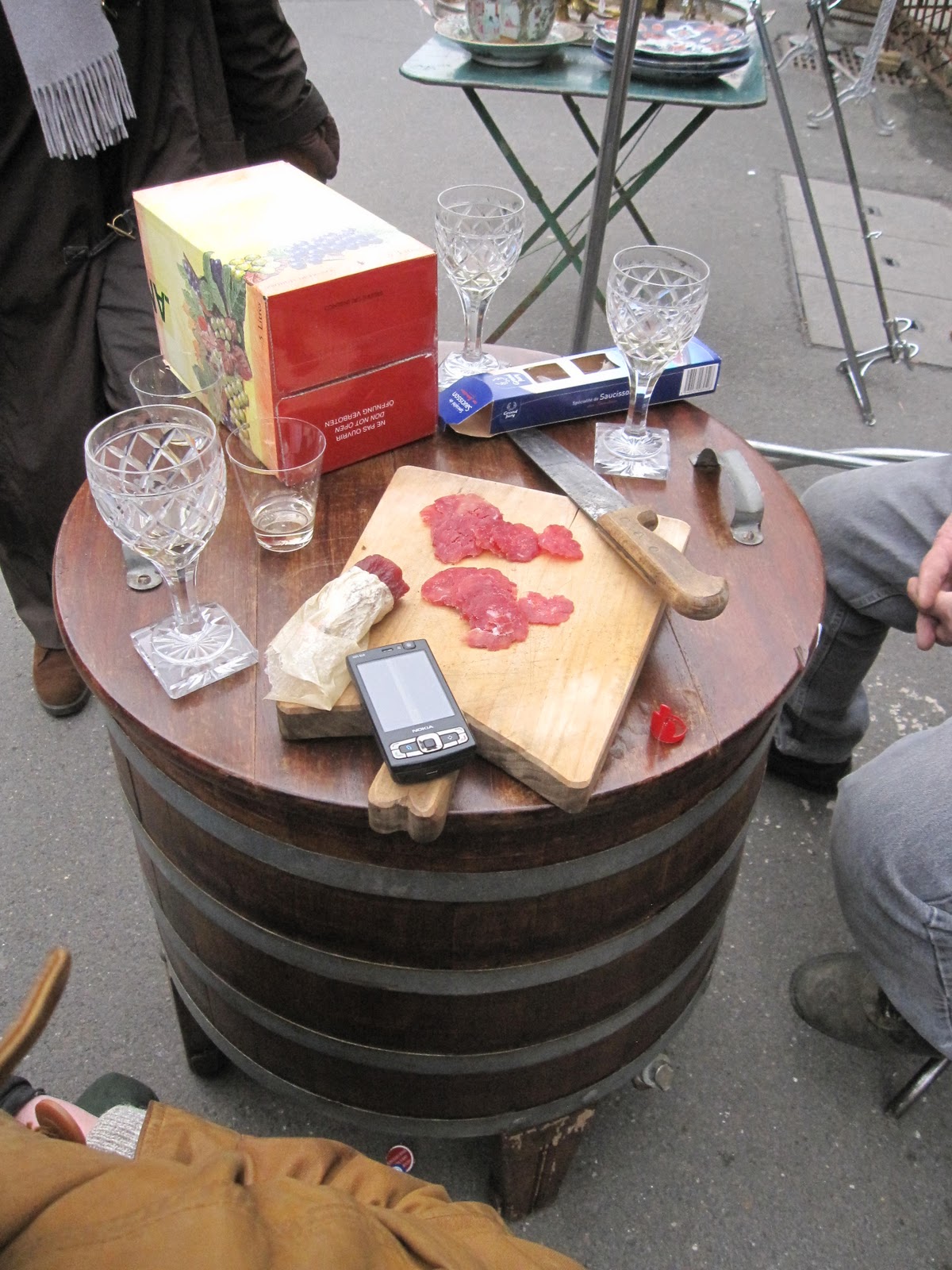 |
| Boxed wine and charcuterie never tasted better. |
 |
| They promised that when I visit them in the Springtime they'll teach me the card game "Belot". |
Sunday, January 30, 2011
Street Smarts
Walking as much as I do in Paris has required that I develop a new set of guiding principles to assist me in navigating various obstacles during my hours spent as a pedestrian in this (perplexing) 'city of lights' (and poop, tripping hazards, and overzealous street cleaners).
By now, six months into this blog, I must sound like a broken record for going on and on about the dog poop found on the sidewalks, gutters, streets, and even in the Metro stations. I am still uncertain if the Metro poops are of canine origin. But I do know one thing- I am missing out on lots of sightseeing and people-watching since most of the time my eyes are looking downward while scanning approximately ten feet ahead (at least my mountain bike training is proving to be useful) for any upcoming nuggets, piles, smears, logs, or skids in varying shades of brown. Guiding principle #1: Scan my environment.
At least once a day, if not I, then another Kaplan family member, alerts the rest of us, "Watch out, right there!" while pointing to the offensive outputs of a dog's last meal. It is comforting to know that if I let my guard down for even one second on Guiding Principle #1, that my peeps have got my back. Or rather, my shoes. Guiding principle #2: Warn my loved ones.
My shoes, most of which I adore just a bit too much- especially my Paris-acquired ones- have yet to come in contact with any poop. I have set a goal for myself; to make it through the entire year without stepping in any, and so far, so good. Ironically, the day that I gave Raelyn my old Ugg boots (her foot, at the moment, is also a size 6) she christened them Parisian by promptly stepping in the stuff. Her peeps apparently failed to heed Guiding Principle #2. Thank goodness our building's courtyard has a hose. Raelyn learned how to use it that day. Guiding principle #3: Do not over-parent and do for my children what they can do for themselves (or what I find too disgusting to handle).
The photos below are part of a series of a dozen poop images that I captured with my camera within a two-block stretch of sidewalk between the grocery store and our apartment building. These Parisian streets are filled with so many of these landmines I wish I owned a hovercraft. Even if I manage to miss the main pile, someone else who didn't has subsequently smeared it in various other places on the sidewalk creating even more obstacles. Guiding Principle #4: Footprints are my friend and a warning device for what's ahead.
In addition to the landmines in the form of dog poop, Paris is a city that surprises me with its numerous puddles of puke. Sure, Paris is a metropolis full of late-night revelers and homeless alcoholics, but so are San Francisco and L.A. and I can't recall the last time I had to quickly veer left while holding my breath because of vomit on the sidewalk in these two cities. My latest theory is this- the seemingly higher incidence of street vomiting is due to Parisians contracting a food-borne illness from undercooked meat. This notion occurredto me last week as I dined at a restaurant while observing my fellow patrons enjoying their steak tartare. The odds of a Parisian ingesting salmonella or E. coli seem to me to be statistically higher than in L.A. or San Francisco because of the sheer volume of raw meat that is consumed here. Despite the U.S. slaughterhouse methods (Food, Inc. anyone?) which probably means that U.S. raw beef statistically has a higher chance of containing these pathogens, at least most chefs in the U.S. cook the meat long enough to kill them off. It's probably a flimsy theory, but I'm sticking by it. You can thank me for not posting any vomit photos. I actually don't have the stomach to take any. Guiding principle # 5: Continue to refrain from eating raw meat.
With all these messes on the streets of Paris, the city's street cleaners have a very important job. Like all civil servants in Paris, these guys (I have yet to see a female street cleaner) are decked out in their spiffy uniforms; in this case bright kelly green and flourecent citron. They even have matching kelly green vehicles. I am grateful for the bureaucrat whose job it was to decide on the color palette for these uniforms because they are really hard to miss. And it is crucial, if you care to stay dry, to stay out of the street cleaner's way, so I especially appreciate their noticeable attire. Guiding principle #6: Cross to the opposite side of the street when I see a street cleaner person or vehicle approaching. In the video you can see the woman, stage left, who is scurrying to get out of the way...
In addition to spraying the streets clean with blasts of water, the street cleaners are also responsible for directing the flow of water into the sewer system that snakes its way underneath the city's streets. They do this with rolled up swaths of what appear to be carpet remnants. These damp and dirty rolls can be found on just about every block in the gutter in front of the sewer grate. Sometimes the roll is turned parallel to the street, sometimes it is turned perpendicular depending on which way the street cleaner wants to direct the flow of water. If you have managed to successfully dodge the street cleaner's hose, you still have to manage to jump over the mini rivers that are flowing in the gutters and sometimes out into the streets.

Guiding principle #7: Employ my puddle-jumping skills when necessary.
Now, if all of this wasn't enough to keep me on my toes while out and about, there are plenty of things that could literally knock me off my feet on these Parisian streets. Living in a society that is not as litigious as my U.S. counterpart means that less attention is payed by the city of Paris towards minimizing potential tripping hazards for its citizens. Soren and I frequently run along Paris's Promenade Plantée, several miles of a former elevated train track that has been turned into a beautifully landscaped recreational trail. Fortunately, we have not been tripped up by the metal plates protruding from the pavement along the way, nor the piles of landscape clippings strewn across the path resulting from the hardworking maintenance crew. The City of Walnut Creek would never willingly allow such hazards to exist on their trails and streets.
I recall reading a Contra Costa Times article about five years ago in which it was explained that the new cobblestone crosswalks that had been installed on the newly-opened section of Locust Street were being replaced because citizens were finding it too difficult to walk upon and a few had even fallen. I would hate to see how these citizens would manage as pedestrians on the streets of cobble-stoned Europe. Guiding principle # 8: Wear sensible (but, of course, fashionable) shoes and continue to scan my environment.
It rains in Paris more often than in Walnut Creek so I almost always have a compact umbrella stashed in my purse. However, I usually only dare to use it when it's really coming down because it is an incredible hassle to jostle myself and my umbrella along the narrow sidewalks of Paris with my fellow umbrella users. I often give up my sidewalk rights to make room for passing pedestrians on clear days. Add umbrellas to the equation and I am looking at a potential poke in the eye and another trip to Dr. Bomhof. Guiding principle # 9: Use my umbrella with extreme care and hope that others do the same.
Imagine my condition had I not been abiding by these nine protective measures: Wet, poop and puke covered shoes, bouts of vomiting, scrapes on my hands and knees from tripping and falling on the sidewalk, and a missing eye. Not a pretty picture. I trust that my guiding principles will keep me safe and sound for the next six months. They have been working well for me so far.
add to those that already me through my everyday existence.
By now, six months into this blog, I must sound like a broken record for going on and on about the dog poop found on the sidewalks, gutters, streets, and even in the Metro stations. I am still uncertain if the Metro poops are of canine origin. But I do know one thing- I am missing out on lots of sightseeing and people-watching since most of the time my eyes are looking downward while scanning approximately ten feet ahead (at least my mountain bike training is proving to be useful) for any upcoming nuggets, piles, smears, logs, or skids in varying shades of brown. Guiding principle #1: Scan my environment.
At least once a day, if not I, then another Kaplan family member, alerts the rest of us, "Watch out, right there!" while pointing to the offensive outputs of a dog's last meal. It is comforting to know that if I let my guard down for even one second on Guiding Principle #1, that my peeps have got my back. Or rather, my shoes. Guiding principle #2: Warn my loved ones.
My shoes, most of which I adore just a bit too much- especially my Paris-acquired ones- have yet to come in contact with any poop. I have set a goal for myself; to make it through the entire year without stepping in any, and so far, so good. Ironically, the day that I gave Raelyn my old Ugg boots (her foot, at the moment, is also a size 6) she christened them Parisian by promptly stepping in the stuff. Her peeps apparently failed to heed Guiding Principle #2. Thank goodness our building's courtyard has a hose. Raelyn learned how to use it that day. Guiding principle #3: Do not over-parent and do for my children what they can do for themselves (or what I find too disgusting to handle).
The photos below are part of a series of a dozen poop images that I captured with my camera within a two-block stretch of sidewalk between the grocery store and our apartment building. These Parisian streets are filled with so many of these landmines I wish I owned a hovercraft. Even if I manage to miss the main pile, someone else who didn't has subsequently smeared it in various other places on the sidewalk creating even more obstacles. Guiding Principle #4: Footprints are my friend and a warning device for what's ahead.
 |
| I would not want to own the bike that belongs to this chain. |
 |
| Where there's poop, there's often pee. These double obstacles are the norm. |
 |
| Footprint warning and additional smear ahead. |
In addition to the landmines in the form of dog poop, Paris is a city that surprises me with its numerous puddles of puke. Sure, Paris is a metropolis full of late-night revelers and homeless alcoholics, but so are San Francisco and L.A. and I can't recall the last time I had to quickly veer left while holding my breath because of vomit on the sidewalk in these two cities. My latest theory is this- the seemingly higher incidence of street vomiting is due to Parisians contracting a food-borne illness from undercooked meat. This notion occurredto me last week as I dined at a restaurant while observing my fellow patrons enjoying their steak tartare. The odds of a Parisian ingesting salmonella or E. coli seem to me to be statistically higher than in L.A. or San Francisco because of the sheer volume of raw meat that is consumed here. Despite the U.S. slaughterhouse methods (Food, Inc. anyone?) which probably means that U.S. raw beef statistically has a higher chance of containing these pathogens, at least most chefs in the U.S. cook the meat long enough to kill them off. It's probably a flimsy theory, but I'm sticking by it. You can thank me for not posting any vomit photos. I actually don't have the stomach to take any. Guiding principle # 5: Continue to refrain from eating raw meat.
With all these messes on the streets of Paris, the city's street cleaners have a very important job. Like all civil servants in Paris, these guys (I have yet to see a female street cleaner) are decked out in their spiffy uniforms; in this case bright kelly green and flourecent citron. They even have matching kelly green vehicles. I am grateful for the bureaucrat whose job it was to decide on the color palette for these uniforms because they are really hard to miss. And it is crucial, if you care to stay dry, to stay out of the street cleaner's way, so I especially appreciate their noticeable attire. Guiding principle #6: Cross to the opposite side of the street when I see a street cleaner person or vehicle approaching. In the video you can see the woman, stage left, who is scurrying to get out of the way...
In addition to spraying the streets clean with blasts of water, the street cleaners are also responsible for directing the flow of water into the sewer system that snakes its way underneath the city's streets. They do this with rolled up swaths of what appear to be carpet remnants. These damp and dirty rolls can be found on just about every block in the gutter in front of the sewer grate. Sometimes the roll is turned parallel to the street, sometimes it is turned perpendicular depending on which way the street cleaner wants to direct the flow of water. If you have managed to successfully dodge the street cleaner's hose, you still have to manage to jump over the mini rivers that are flowing in the gutters and sometimes out into the streets.

Guiding principle #7: Employ my puddle-jumping skills when necessary.
Now, if all of this wasn't enough to keep me on my toes while out and about, there are plenty of things that could literally knock me off my feet on these Parisian streets. Living in a society that is not as litigious as my U.S. counterpart means that less attention is payed by the city of Paris towards minimizing potential tripping hazards for its citizens. Soren and I frequently run along Paris's Promenade Plantée, several miles of a former elevated train track that has been turned into a beautifully landscaped recreational trail. Fortunately, we have not been tripped up by the metal plates protruding from the pavement along the way, nor the piles of landscape clippings strewn across the path resulting from the hardworking maintenance crew. The City of Walnut Creek would never willingly allow such hazards to exist on their trails and streets.
I recall reading a Contra Costa Times article about five years ago in which it was explained that the new cobblestone crosswalks that had been installed on the newly-opened section of Locust Street were being replaced because citizens were finding it too difficult to walk upon and a few had even fallen. I would hate to see how these citizens would manage as pedestrians on the streets of cobble-stoned Europe. Guiding principle # 8: Wear sensible (but, of course, fashionable) shoes and continue to scan my environment.
 |
| One of Paris's many sidewalk hazards |
It rains in Paris more often than in Walnut Creek so I almost always have a compact umbrella stashed in my purse. However, I usually only dare to use it when it's really coming down because it is an incredible hassle to jostle myself and my umbrella along the narrow sidewalks of Paris with my fellow umbrella users. I often give up my sidewalk rights to make room for passing pedestrians on clear days. Add umbrellas to the equation and I am looking at a potential poke in the eye and another trip to Dr. Bomhof. Guiding principle # 9: Use my umbrella with extreme care and hope that others do the same.
 | ||
| Umbrellas cannot fit under the scaffolding on the sidewalk. Notice how the umbrella woman is close to receiving a poke in the eye from another umbrella? |
Imagine my condition had I not been abiding by these nine protective measures: Wet, poop and puke covered shoes, bouts of vomiting, scrapes on my hands and knees from tripping and falling on the sidewalk, and a missing eye. Not a pretty picture. I trust that my guiding principles will keep me safe and sound for the next six months. They have been working well for me so far.
add to those that already me through my everyday existence.
Saturday, January 29, 2011
What's Up Doc?
One of my biggest fears about moving to Paris was health care; finding a doctor, which emergency numbers to dial if necessary, knowing the location of the nearest hospital, and how to communicate our needs and problems effectively in a foreign language. Luckily, none of us have any chronic health conditions that need ongoing attention. I really hoped that we would manage to make it through the year without needing to seek medical attention. Wishful thinking. Six months into our life here and we have sought medical assistance twice now. It's been amusingly interesting to compare and contrast the French health care system to that of the U.S.
We averted our first opportunity to access the French health care system in late August when Raelyn's cast, which was due to come off at a doctor's office at the American Hospital outside of Paris, just happened to unravel itself. Actually, it had a little help in the form of Raelyn taking a bath and then peeling it off of her arm, but it saved us from making the trip all the way out to Neuilly sur Seine when what we really hoped for was to find an English-speaking doctor in our neighborhood.
Soon after, we learned that if you ask your local pharmacist, they will give you a referral to a doctor in the neighborhood. No need to call a Member Services department to verify that your desired physician is in-network. All that we wanted and got, easily enough, was a good word from the pharmacist about an Eglish-speaking physician that was in-neighborhood. Soren returned from the pharmacy with a little slip of scratch paper upon which the pharmacist had scrawled the doctor's name, address, and phone number. This little slip of paper provided me with much relief.
By mid-October, we decided that we should take preventative measures, like we do back home every year, and get flu shots. Soren had already received his shot at Kaiser's flu vaccine clinic during one of his business trips back home. Paris, to my knowledge, does not offer any flu vaccine clinics at hospitals or drug stores. Instead, it works like this: First, purchase our flu vaccines at the pharmacy. Each vaccine comes in a small rectangular box stamped with an expiration date. Total cost for three vaccines = 30 euros (Kaiser's flu vaccination clinics = $0). Second, refrigerate the vaccines at home until our appointment time. Third, call and schedule the vaccination appointment with the doctor. Soren did a great job of managing to arrange our appointment in French because the receptionist that answered the phone did not speak English. Finally, arrive at our appointment with our baggie of vaccines. Can you imagine this system in the U.S.? Patients responsible for purchasing, storing, and transporting their own vaccines? We even heard that some French people skip the doctor's visit altogether and simply inject themselves at home. No thank you.


Upon arriving at the doctor's building, we press the door buzzer to notify him that we have arrived. The building's door buzzes and we enter. We ascend one flight of stairs and reach his office door. The doctor's waiting room, on the other side of this door, is small; a few chairs, an end table with magazines, and a coat rack. What is missing is a receptionist behind a counter, the front office of the doctor's office (a.k.a., the Gatekeeper). With no one to check-in with and officially announce our arrival, we take a seat and wait. Just a few minutes later (as opposed to Kaiser's standard 20 minutes) another door opens and Dr. Bomhof introduces himself to us and ushers us into his office. There is a desk, an exam table, and a credenza filled with books. The doctor takes a seat behind his desk, invites us to take a seat, and we proceed to get acquainted.
Dr. Bomhof is Dutch, he studied medicine in Paris, and has been here ever since. He is pleasant and personable, his English is excellent. He asked us lots of questions, not about our health history, but about where we are from and what brings us to Paris. The short answer is always, "Because of my husband's work." We never get away with the short answer. It always turns into answering, "What line of work is that?" and then the French are even more curious when they learn Soren is self-employed (entrepreneurs are a rare breed in France) and not an employee of a big company that has stationed us as expats in Paris. Follow-up questions usually include, "Why Paris?", "How long?", and my personal favorite directed at me, "And, what do you do?" Um, it's called trying to raise two decent human beings.
I had read in one of my books that the French are not into asking about what one does for a living, but rather, what one is. From their perspective however, it is typical for French mothers to have a career, most here do. What they don't understand, however, is that I am not offered government-subsidized child care in my country and that the costs of childcare would likely outweigh my earning potential, not to mention that with a husband who travels a ton, paying somebody else to raise our kids so that I can have a career isn't a choice that works for me. I guess it's just another way of saying that I want to be sure it is my presence that sends my kids to therapy someday rather than my absence.
After concluding our lengthy introduction (a far cry from Kaiser's 10-minute total visit rule), Dr. Bomhof wants to know why we are interested in receiving the flu vaccine. Short answer: Because we get it every year. "But why?" he inquires, "You are young and healthy, no?" Long answer: Because the U.S. medical profession tell us to, Soren spends a lot of time on planes, and we don't want to get sick and visit you more than we have to. The doctor chuckles. He explains that very few French (under the age of 60) receive an annual flu shot and, in fact, last year, with the H1N1 scare, France organized a flu vaccine campaign that wound up being poorly-received and many vaccinations went to waste. He humored us since we had gone to the trouble of purchasing, refrigerating, and presenting our vaccines to him and injected us despite that fact that he thought we were being a bit silly and overcautious. Total cost for three injections = 50 euros (per-visit copay at Kaiser per our plan = $100. We elected a Kaiser plan with a lower monthly premium but higher copays in order to ensure greater inpatient and long-term care coverage. We see the doctor so infrequently, but every time we do, I think, 'ouch'!). Dr. Bomhof said that we can choose to pay him cash on the spot or send him a check. We payed cash and he wrote a receipt. No front office necessary apparently. I began to wonder where he is hiding the French receptionist that Soren had spoken to originally.

Fast-forward to mid-January. It is the night before the girls and I are to depart on a train headed to Brugges, Belgium. Soren, who has been in the Netherlands, is meeting us there during his weekend break from teaching at the university in Breda. I was in the kitchen cooking dinner when I hear a shrill scream and loud crying coming from the dining room. It turns out that Nola has been attacked by two dining chairs. One hit her on the back of her head, the other one simultaneously crashed into her nose. I find her crumpled on the floor lying amidst the felled chairs while cradling her head and nose in her hands. She has a huge bump on the back of her head and a gash across the bridge of her nose that is bleeding while it begins to swell (for the unusual story about how this injury occurred, check out Nola's blog:
www.nolasadventureinparis.blogsppot.com). After assessing that her cut did not require stitches, she sat icing her injuries while I googled information about broken noses. Based on what I read, I made an initial judgement call that her nose was not broken. My motto became, 'Have Ibuprofen and BandAids, Will Travel', and off we went to our weekend in Brugges. Nola was a trooper, BandAid and all.

By the time we returned on Sunday evening, I was beginning to doubt my initial assessment and began to worry that her nose might indeed be broken. On Monday morning, Soren called Dr. Bomhof's office from the Netherlands, expecting to reach the French receptionist, but no one answered the phone, it just rang and rang. At least with Kaiser, the phone is answered, even if you are just listening to Muzak while waiting your turn in the queue, knowing that eventually, someone will pick up. Even if it is to put you back on hold again. Not that I would equate this with true customer service, but at least it's a step in the right direction. The French don't even try to grasp the concept of customer service (except for 5-star hotels and Michelin-rated restaurants) and not receiving a live person or automated greeting at the doctor's office was just another example of this. Soren called again on Tuesday, the phone was answered by the receptionist and he succeeded in making an appointment for Nola.
When we arrived, we again waited only a few minutes in his waiting room and Dr. Bomhof and I carried on a nice conversation about Brugges and the Netherlands while he examined Nola. He directed me to take her for an x-ray. My insides immediately tightened up because I felt fearful leaving the comfort and confines of nice English-speaking Dr. Bomhof's office and venturing out into the wider circle of French health care. The doctor made it sound simple enough. He simply placed a call to his radiologist colleague and informed him of our impending arrival, gave me his address (which was only a block away) and a medical form, and off we went. I was instructed to return to Dr. Bomhof's office directly from the radiologist's.
When we arrived at the radiologist's office, I was initially confused as to where to go and to whom I present Nola's form. We were inside an 18th century building that was clearly a former home. The living room was now a waiting room (complete with original wood floors, fireplace, and crown mouldings) and the former dining room was the front office. There was nothing 'front' about this front office at all because it was separated from the waiting room by a grand staircase and had I not had the girls help translate the signs on the wall for me, we would have remained seated in the waiting room for who knows how long. After all, I was already accustomed to Dr. Bomhof's system of no front office receptionist.
We approached the receptionist and I apologized to her, "Désolé, mon français est terrible. Nous sommes ici pour ma fille, Nola." I handed her the form and she asked me, "Vous avez la carte vitale et la sécurité sociale pour Nola?" I swallow the gulp forming in my throat and simply reply, "Non." I begin to worry that she is judging me as an unfit mother, showing up to an appointment without the necessary documents. I found myself wondering if I will be able to understand her when she tells us that we will have to come back another day with the appropriate documentation. I quickly speak up in the hopes of preventing such a scenario and state, "Je paie avec cash, si vous plait." Money talks, right? And a si vous plait never hurts. Cost of xray = 32.40 euros (as opposed to another $100 Kaiser copay). Next thing I knew, she handed me a form and directed us to wait our turn in the waiting room. Thirty minutes and one xray later, we returned with xray in hand to Dr. Bomhof's waiting room. A young man was already seated and five minutes later when the doctor opened his office door, he explained to this patient, in French, to please be patient, he is going to see the child first. I was already fond of Dr. Bomhof, but this preferential treatment sealed the deal.
One look at Nola's x-ray confirmed that my initial assessment was correct. Not broken. Phew! I now gave myself permission to stop feeling guilty about taking our broken-nosed child on a weekend trip to Brugges. Dr. Bomhof wrote a note excusing Nola from her physical activities for the upcoming week and gave us the x-ray to take home. In France, the patient is responsible for keeping and maintaining all medical records. So Nola is now the proud owner of a really cool head shot. Total cost of Dr. Bomhof's exam = 40 euros (again, better than our customary $100 copay).

We received an explanation today, from one of Soren's relatives, about the carte vitale and sécurité sociale that the radiologist's office asked for. The French citizen's carte vitale is their basic health insurance card that covers them for basic medical care. The card is embedded with a microchip and contains one's social security insurance details. The card is presented to the doctor who places it into a card reader enabling direct reimbursement from the insurance fund. Reimbursements are placed directly into one's bank account, normally within a week.
This relative explained that, as French citizens, the incurred costs of the girls' care would be reimbursed to us at 50-70% had we been able to present this identification. Soren too, is eligible as a French citizen. But, we have chosen to fly under the radar, so-to-speak, since his income is not derived from France and therefore he does not pay into France's social security system. This means we are uninsured here in France.
Let's just say, for the sake of comparison, that Nola and Raelyn did possess a French-issued insurance card linked to a French social security number. That means that our total out-of-pocket medical expenses (after reimbursement at 50% for the past six months) would total 74 euros. This total even includes my non-reimbursable flu innoculation cost since I am non-citizen. That's a far cry from the $300 in copays we would have incurred with Kaiser for the same treatment. Not to mention, that a U.S. primary care physician would not do an initial intake with new patients as a family like Dr. Bomhof did with the four of us. Each of us would have had to be seen individually and incur individual copays for these initial visits. How much would it cost for an uninsured U.S. citizen to receive an exam from a primary care physician and obtain an x-ray from a radiologist? My guess is substantially more than $100 (calculated exchange rate). Based on this alone, it is easy to see how and why France has been described by the World Health Organization for providing the best overall health care in the world. I sure wish U.S. policy-makers would try a dose of this medicine.
We averted our first opportunity to access the French health care system in late August when Raelyn's cast, which was due to come off at a doctor's office at the American Hospital outside of Paris, just happened to unravel itself. Actually, it had a little help in the form of Raelyn taking a bath and then peeling it off of her arm, but it saved us from making the trip all the way out to Neuilly sur Seine when what we really hoped for was to find an English-speaking doctor in our neighborhood.
Soon after, we learned that if you ask your local pharmacist, they will give you a referral to a doctor in the neighborhood. No need to call a Member Services department to verify that your desired physician is in-network. All that we wanted and got, easily enough, was a good word from the pharmacist about an Eglish-speaking physician that was in-neighborhood. Soren returned from the pharmacy with a little slip of scratch paper upon which the pharmacist had scrawled the doctor's name, address, and phone number. This little slip of paper provided me with much relief.
By mid-October, we decided that we should take preventative measures, like we do back home every year, and get flu shots. Soren had already received his shot at Kaiser's flu vaccine clinic during one of his business trips back home. Paris, to my knowledge, does not offer any flu vaccine clinics at hospitals or drug stores. Instead, it works like this: First, purchase our flu vaccines at the pharmacy. Each vaccine comes in a small rectangular box stamped with an expiration date. Total cost for three vaccines = 30 euros (Kaiser's flu vaccination clinics = $0). Second, refrigerate the vaccines at home until our appointment time. Third, call and schedule the vaccination appointment with the doctor. Soren did a great job of managing to arrange our appointment in French because the receptionist that answered the phone did not speak English. Finally, arrive at our appointment with our baggie of vaccines. Can you imagine this system in the U.S.? Patients responsible for purchasing, storing, and transporting their own vaccines? We even heard that some French people skip the doctor's visit altogether and simply inject themselves at home. No thank you.


Upon arriving at the doctor's building, we press the door buzzer to notify him that we have arrived. The building's door buzzes and we enter. We ascend one flight of stairs and reach his office door. The doctor's waiting room, on the other side of this door, is small; a few chairs, an end table with magazines, and a coat rack. What is missing is a receptionist behind a counter, the front office of the doctor's office (a.k.a., the Gatekeeper). With no one to check-in with and officially announce our arrival, we take a seat and wait. Just a few minutes later (as opposed to Kaiser's standard 20 minutes) another door opens and Dr. Bomhof introduces himself to us and ushers us into his office. There is a desk, an exam table, and a credenza filled with books. The doctor takes a seat behind his desk, invites us to take a seat, and we proceed to get acquainted.
Dr. Bomhof is Dutch, he studied medicine in Paris, and has been here ever since. He is pleasant and personable, his English is excellent. He asked us lots of questions, not about our health history, but about where we are from and what brings us to Paris. The short answer is always, "Because of my husband's work." We never get away with the short answer. It always turns into answering, "What line of work is that?" and then the French are even more curious when they learn Soren is self-employed (entrepreneurs are a rare breed in France) and not an employee of a big company that has stationed us as expats in Paris. Follow-up questions usually include, "Why Paris?", "How long?", and my personal favorite directed at me, "And, what do you do?" Um, it's called trying to raise two decent human beings.
I had read in one of my books that the French are not into asking about what one does for a living, but rather, what one is. From their perspective however, it is typical for French mothers to have a career, most here do. What they don't understand, however, is that I am not offered government-subsidized child care in my country and that the costs of childcare would likely outweigh my earning potential, not to mention that with a husband who travels a ton, paying somebody else to raise our kids so that I can have a career isn't a choice that works for me. I guess it's just another way of saying that I want to be sure it is my presence that sends my kids to therapy someday rather than my absence.
After concluding our lengthy introduction (a far cry from Kaiser's 10-minute total visit rule), Dr. Bomhof wants to know why we are interested in receiving the flu vaccine. Short answer: Because we get it every year. "But why?" he inquires, "You are young and healthy, no?" Long answer: Because the U.S. medical profession tell us to, Soren spends a lot of time on planes, and we don't want to get sick and visit you more than we have to. The doctor chuckles. He explains that very few French (under the age of 60) receive an annual flu shot and, in fact, last year, with the H1N1 scare, France organized a flu vaccine campaign that wound up being poorly-received and many vaccinations went to waste. He humored us since we had gone to the trouble of purchasing, refrigerating, and presenting our vaccines to him and injected us despite that fact that he thought we were being a bit silly and overcautious. Total cost for three injections = 50 euros (per-visit copay at Kaiser per our plan = $100. We elected a Kaiser plan with a lower monthly premium but higher copays in order to ensure greater inpatient and long-term care coverage. We see the doctor so infrequently, but every time we do, I think, 'ouch'!). Dr. Bomhof said that we can choose to pay him cash on the spot or send him a check. We payed cash and he wrote a receipt. No front office necessary apparently. I began to wonder where he is hiding the French receptionist that Soren had spoken to originally.

Fast-forward to mid-January. It is the night before the girls and I are to depart on a train headed to Brugges, Belgium. Soren, who has been in the Netherlands, is meeting us there during his weekend break from teaching at the university in Breda. I was in the kitchen cooking dinner when I hear a shrill scream and loud crying coming from the dining room. It turns out that Nola has been attacked by two dining chairs. One hit her on the back of her head, the other one simultaneously crashed into her nose. I find her crumpled on the floor lying amidst the felled chairs while cradling her head and nose in her hands. She has a huge bump on the back of her head and a gash across the bridge of her nose that is bleeding while it begins to swell (for the unusual story about how this injury occurred, check out Nola's blog:
www.nolasadventureinparis.blogsppot.com). After assessing that her cut did not require stitches, she sat icing her injuries while I googled information about broken noses. Based on what I read, I made an initial judgement call that her nose was not broken. My motto became, 'Have Ibuprofen and BandAids, Will Travel', and off we went to our weekend in Brugges. Nola was a trooper, BandAid and all.

By the time we returned on Sunday evening, I was beginning to doubt my initial assessment and began to worry that her nose might indeed be broken. On Monday morning, Soren called Dr. Bomhof's office from the Netherlands, expecting to reach the French receptionist, but no one answered the phone, it just rang and rang. At least with Kaiser, the phone is answered, even if you are just listening to Muzak while waiting your turn in the queue, knowing that eventually, someone will pick up. Even if it is to put you back on hold again. Not that I would equate this with true customer service, but at least it's a step in the right direction. The French don't even try to grasp the concept of customer service (except for 5-star hotels and Michelin-rated restaurants) and not receiving a live person or automated greeting at the doctor's office was just another example of this. Soren called again on Tuesday, the phone was answered by the receptionist and he succeeded in making an appointment for Nola.
When we arrived, we again waited only a few minutes in his waiting room and Dr. Bomhof and I carried on a nice conversation about Brugges and the Netherlands while he examined Nola. He directed me to take her for an x-ray. My insides immediately tightened up because I felt fearful leaving the comfort and confines of nice English-speaking Dr. Bomhof's office and venturing out into the wider circle of French health care. The doctor made it sound simple enough. He simply placed a call to his radiologist colleague and informed him of our impending arrival, gave me his address (which was only a block away) and a medical form, and off we went. I was instructed to return to Dr. Bomhof's office directly from the radiologist's.
When we arrived at the radiologist's office, I was initially confused as to where to go and to whom I present Nola's form. We were inside an 18th century building that was clearly a former home. The living room was now a waiting room (complete with original wood floors, fireplace, and crown mouldings) and the former dining room was the front office. There was nothing 'front' about this front office at all because it was separated from the waiting room by a grand staircase and had I not had the girls help translate the signs on the wall for me, we would have remained seated in the waiting room for who knows how long. After all, I was already accustomed to Dr. Bomhof's system of no front office receptionist.
We approached the receptionist and I apologized to her, "Désolé, mon français est terrible. Nous sommes ici pour ma fille, Nola." I handed her the form and she asked me, "Vous avez la carte vitale et la sécurité sociale pour Nola?" I swallow the gulp forming in my throat and simply reply, "Non." I begin to worry that she is judging me as an unfit mother, showing up to an appointment without the necessary documents. I found myself wondering if I will be able to understand her when she tells us that we will have to come back another day with the appropriate documentation. I quickly speak up in the hopes of preventing such a scenario and state, "Je paie avec cash, si vous plait." Money talks, right? And a si vous plait never hurts. Cost of xray = 32.40 euros (as opposed to another $100 Kaiser copay). Next thing I knew, she handed me a form and directed us to wait our turn in the waiting room. Thirty minutes and one xray later, we returned with xray in hand to Dr. Bomhof's waiting room. A young man was already seated and five minutes later when the doctor opened his office door, he explained to this patient, in French, to please be patient, he is going to see the child first. I was already fond of Dr. Bomhof, but this preferential treatment sealed the deal.
One look at Nola's x-ray confirmed that my initial assessment was correct. Not broken. Phew! I now gave myself permission to stop feeling guilty about taking our broken-nosed child on a weekend trip to Brugges. Dr. Bomhof wrote a note excusing Nola from her physical activities for the upcoming week and gave us the x-ray to take home. In France, the patient is responsible for keeping and maintaining all medical records. So Nola is now the proud owner of a really cool head shot. Total cost of Dr. Bomhof's exam = 40 euros (again, better than our customary $100 copay).

We received an explanation today, from one of Soren's relatives, about the carte vitale and sécurité sociale that the radiologist's office asked for. The French citizen's carte vitale is their basic health insurance card that covers them for basic medical care. The card is embedded with a microchip and contains one's social security insurance details. The card is presented to the doctor who places it into a card reader enabling direct reimbursement from the insurance fund. Reimbursements are placed directly into one's bank account, normally within a week.
This relative explained that, as French citizens, the incurred costs of the girls' care would be reimbursed to us at 50-70% had we been able to present this identification. Soren too, is eligible as a French citizen. But, we have chosen to fly under the radar, so-to-speak, since his income is not derived from France and therefore he does not pay into France's social security system. This means we are uninsured here in France.
Let's just say, for the sake of comparison, that Nola and Raelyn did possess a French-issued insurance card linked to a French social security number. That means that our total out-of-pocket medical expenses (after reimbursement at 50% for the past six months) would total 74 euros. This total even includes my non-reimbursable flu innoculation cost since I am non-citizen. That's a far cry from the $300 in copays we would have incurred with Kaiser for the same treatment. Not to mention, that a U.S. primary care physician would not do an initial intake with new patients as a family like Dr. Bomhof did with the four of us. Each of us would have had to be seen individually and incur individual copays for these initial visits. How much would it cost for an uninsured U.S. citizen to receive an exam from a primary care physician and obtain an x-ray from a radiologist? My guess is substantially more than $100 (calculated exchange rate). Based on this alone, it is easy to see how and why France has been described by the World Health Organization for providing the best overall health care in the world. I sure wish U.S. policy-makers would try a dose of this medicine.
Tuesday, January 11, 2011
Grocery-Go-Getting
I have been neglecting my blog! The title of this post may lead you to believe that I have been so busy shopping that I have not had time to blog. Well, that's only partly true. I have also been busy traveling for two weeks (freezing my buns off is more like it, just doing it in cities other than Paris), nit picking and de-lousing the girls, sharing my computer with the two other bloggers in the household, travel planning (Italy in April), exploring more of Paris, and single-parenting (Soren is gone for three weeks). All of this does not leave much time for blogging, nor shopping for that matter. But, being that I am the house manager and responsible for getting food on the table, I cannot neglect the grocery shopping, unfortunately.
My shopping know-how has evolved since my earlier post ("Shopping in Paris: Je Ne Comprend Pas"). For example, my keen eyes and ears have picked up on the fact that one is not expected to greet the security guards that are posted at the entrances and exits of every non-boutique store. In the first couple of months here I was so intent on not being perceived as rude that I greeted anybody and everybody with a polite, "Bonjour," upon entering a place of business. I soon realized that nobody else acknowledges the security staff. I have no idea why, it must be another one of France's unwritten rules. They never responded to my hello's anyway so I guess they're not allowed to talk to customers.
I have learned to say, "J' ai un sac," to prevent the clerks from placing my items in one of their plastic bags. I don't want to add to the Texas-size trash heap in the Pacific. When heading to my local Franprix, Monoprix, or Picard to pick up groceries, I am toting one of my Lululemon bags on my shoulder while trailing my rolling cart behind me. I usually try to make sure that the side of the Lululemon bag with the punchy statements is facing out because I like to get a kick out of watching the French read these funny quips such as, "Do one thing a day that scares you." Or, "Dance, Sing, Floss, and Travel". I can always tell when they are reading my sac because many of the quotes are printed sideways and I see the reader's head tilting.
Traveling with a rolling cart is quite an exercise in maneuvering. First, one has to manage to roll this contraption up and down stairs, both at the apartment building, the store, and the Metro. Much easier when going, not so when coming home with a cart full of items. Second, one has to navigate the sidewalks, some so narrow that there is room for only one person of average girth plus their cart. Add to this a baguette sticking out of the cart sideways and an approaching pedestrian and you have yourself three options: Forge ahead and pretend you do not see the pedestrian, stop and turn yourself sideways while pulling your cart to the side as well to create a slim margin for passing, or, move yourself and your cart into the street and give up your rights to the sidewalk. Meanwhile, you hope that your baguette makes it though this maneuvering unscathed. I have tried all three approaches. I do not have a preferred method, it's an in-the-moment quick thinking type of thing. Second, the dog poop. It's one thing to make your brain make your feet step over these messes, it's another to simultaneously swerve a heavy cart around them. I care more about my shoes than I do the wheels of the cart. I try not to think about what those wheels are tracking into the apartment.
The grocery store errand is a stressful one in my life here for many reasons. It's hot inside the stores. I always regret wearing my coat once inside the store because I am eager to remove it, but I don't have enough hands to carry it, pull my cart, and collect my items. So I sweat it out. The Monoprix, where I usually shop, is two stories. Up top are the household goods and drugstore items, down below are the groceries. The entrance is at the top level so I collect those items first, put them in my Lululemon bag and then take the elevator downstairs. At this point I start hoping that all the items on my list are in-stock and in a logical location because I don't always have the skills to ask for them if I cannot find them. Last week, I spent a good ten minutes searching high and low for baking soda. No luck. Yesterday I found it by accident. Next to the pickles and ketchup. The baking section is not even in the same aisle. What are they thinking? Granted, I was on auto-pilot keeping my eyes peeled for the yellow box I am accustomed to back home. The brand this store carries is blue. Reprogramming myself is clearly necessary.
The grocery clerks here are sedentary. They do not stand, they sit perched on stools, chatting away with their fellow cashiers while slowly, mindlessly, and carelessly tossing my items down the counter to the other end where they make a soft 'thwack' against the barrier. Of course, I say, "Bonjour," but it hardly seems worth the effort because the response I get is always a robotic and listless 'bonjour' back at me. The quality of my bonjour (yes, I have played around with it) has not produced any marked effect on the clerk's treatment of me or my groceries. I know the French are supposed to be all about who they are, not what they do, but a little pride in a job well done would be really appreciated by me in this regard.
As with collecting my groceries, at the checkout counter, again, it's all about strategy. I have to unload the light items first, obviously, because they are on top of the cart. However, I can't let the clerk process them first because if I do, she will send them down to the end of the counter followed by the heavy stuff and a sad crushing will occur. The difficulty with this is that the counter space for unloading groceries is very small so there is a lack of room to store my produce and bread until I am ready to send them towards the cashier after the heavy items. So I resort to creating a produce tower topped by a loaf of bread at the edge of the counter, farthest away from the cashier, hoping it does not topple to the floor while I am processing the heaviest items.I have become pretty skilled at playing blocks with produce.
After managing my topple-less tower, my anxiety increases further still because there are no baggers. At this point in the checkout process I have to dash down to the end of the counter and start the heavy-light process all over again, although at warp speed. This is because the clerk does not wait for my items to be removed from the counter before sending down those of the next customer. Usually, I am 3/4 of the way done with placing my items back in the cart when it is time to break to pay the bill. This too, I have mastered with speech, "Je paie avec carte de crédit." It is necessary to verbally declare my method of payment because Parisians rarely use credit cards (at least for grocery purchases). Instead they use cash, debit cards, or old-school checks (when is the last time you have waited in line behind a check writer?). Upon learning that I am paying with my credit card she pushes a special button on her machine that allows for this atypical transaction. By the time I am signing the receipt, the next customer's items are flying down towards mine and it's time to get back to bagging. By the time I am done with this necessary evil of an errand, I am ready for a cocktail. Make it a Kir Royale. Is 11:00 a.m. too early for a drink?
One time, I stopped in a Franprix spontaneously remembering a needed item and I was without my sac. The customer behind me in line finished her transaction and had left the store while I was still struggling to wrestle open one of their plastic grocery bags. My germophobia prevents me from engaging in the sure-fire way to open the bag; finger-licking. So I sat there for an eternity using the 'making-fire' technique instead. Nobody offered any assistance. Probably because they had me pegged for the fool that I am in not finger-licking and they wanted to watch me suffer.
The only time I have felt good upon leaving my local Monoprix was two weeks ago. Here's why: My clerk was so busy talking to the clerk behind her that she did not realize that some of my tomatoes had escaped from their bag due to her careless handling of them.She tossed the bag down towards me and when I realized some tomatoes were missing I looked up and saw that one was still on the scale to her right, too far away for me to reach. Meanwhile, she had swiveled on her stool so that her upper body twisted around towards her clerk-friend (it always helps to make eye-contact when in a deep and meaningful conversation with a co-worker). Because I couldn't think quick enough on my feet to muster the words for, "My tomato is lost and forgotten over there and would like to be reunited with its family," I simply extended my arm and pointed at it, right at the same time my clerk swiveled back around to attend to the less important task of processing my groceries. Her swivel motion + my arm extension = Collision. Her face crashed into my arm and her eyeglasses were knocked askew. It looked like it hurt. I immediately offered a polite, "Je suis désolé Madame," while feeling like she should really be the one apologizing to me for not doing her job. She gave me a very perturbed look, took her glasses off, put them on, took them off, readjusted them, put them back on and then swiveled back towards her clerk-friend. My five months here have provided me with enough understanding so as to know that what she said next was something along the lines of, "This bitch just broke my glasses!" All the usual stress at the checkout stand left my body in that very moment. Now all I felt was anger. How dare she blame her carelessness, her lackadaisical behavior, and what clearly was an accident on me! If only I knew more French, I would have had some choice words for her. As it was, all I could muster was my most exaggerated eye glare possible along with a tightly clenched jaw while saying this through clenched teeth with a low voice, "C'est un accident, dé-so-lé." I drew out the sorry part so that she would hopefully catch all my cues about the fact that I knew she was talking @#$!&% about me. By the look on her face, I knew she got my drift. I also took the fact that she said, "Au revoir," before I did as a sign that I had won our little checkout battle.
Note to self: Learn some French swear words.
My shopping know-how has evolved since my earlier post ("Shopping in Paris: Je Ne Comprend Pas"). For example, my keen eyes and ears have picked up on the fact that one is not expected to greet the security guards that are posted at the entrances and exits of every non-boutique store. In the first couple of months here I was so intent on not being perceived as rude that I greeted anybody and everybody with a polite, "Bonjour," upon entering a place of business. I soon realized that nobody else acknowledges the security staff. I have no idea why, it must be another one of France's unwritten rules. They never responded to my hello's anyway so I guess they're not allowed to talk to customers.
I have learned to say, "J' ai un sac," to prevent the clerks from placing my items in one of their plastic bags. I don't want to add to the Texas-size trash heap in the Pacific. When heading to my local Franprix, Monoprix, or Picard to pick up groceries, I am toting one of my Lululemon bags on my shoulder while trailing my rolling cart behind me. I usually try to make sure that the side of the Lululemon bag with the punchy statements is facing out because I like to get a kick out of watching the French read these funny quips such as, "Do one thing a day that scares you." Or, "Dance, Sing, Floss, and Travel". I can always tell when they are reading my sac because many of the quotes are printed sideways and I see the reader's head tilting.
Traveling with a rolling cart is quite an exercise in maneuvering. First, one has to manage to roll this contraption up and down stairs, both at the apartment building, the store, and the Metro. Much easier when going, not so when coming home with a cart full of items. Second, one has to navigate the sidewalks, some so narrow that there is room for only one person of average girth plus their cart. Add to this a baguette sticking out of the cart sideways and an approaching pedestrian and you have yourself three options: Forge ahead and pretend you do not see the pedestrian, stop and turn yourself sideways while pulling your cart to the side as well to create a slim margin for passing, or, move yourself and your cart into the street and give up your rights to the sidewalk. Meanwhile, you hope that your baguette makes it though this maneuvering unscathed. I have tried all three approaches. I do not have a preferred method, it's an in-the-moment quick thinking type of thing. Second, the dog poop. It's one thing to make your brain make your feet step over these messes, it's another to simultaneously swerve a heavy cart around them. I care more about my shoes than I do the wheels of the cart. I try not to think about what those wheels are tracking into the apartment.
The grocery store errand is a stressful one in my life here for many reasons. It's hot inside the stores. I always regret wearing my coat once inside the store because I am eager to remove it, but I don't have enough hands to carry it, pull my cart, and collect my items. So I sweat it out. The Monoprix, where I usually shop, is two stories. Up top are the household goods and drugstore items, down below are the groceries. The entrance is at the top level so I collect those items first, put them in my Lululemon bag and then take the elevator downstairs. At this point I start hoping that all the items on my list are in-stock and in a logical location because I don't always have the skills to ask for them if I cannot find them. Last week, I spent a good ten minutes searching high and low for baking soda. No luck. Yesterday I found it by accident. Next to the pickles and ketchup. The baking section is not even in the same aisle. What are they thinking? Granted, I was on auto-pilot keeping my eyes peeled for the yellow box I am accustomed to back home. The brand this store carries is blue. Reprogramming myself is clearly necessary.
The grocery clerks here are sedentary. They do not stand, they sit perched on stools, chatting away with their fellow cashiers while slowly, mindlessly, and carelessly tossing my items down the counter to the other end where they make a soft 'thwack' against the barrier. Of course, I say, "Bonjour," but it hardly seems worth the effort because the response I get is always a robotic and listless 'bonjour' back at me. The quality of my bonjour (yes, I have played around with it) has not produced any marked effect on the clerk's treatment of me or my groceries. I know the French are supposed to be all about who they are, not what they do, but a little pride in a job well done would be really appreciated by me in this regard.
As with collecting my groceries, at the checkout counter, again, it's all about strategy. I have to unload the light items first, obviously, because they are on top of the cart. However, I can't let the clerk process them first because if I do, she will send them down to the end of the counter followed by the heavy stuff and a sad crushing will occur. The difficulty with this is that the counter space for unloading groceries is very small so there is a lack of room to store my produce and bread until I am ready to send them towards the cashier after the heavy items. So I resort to creating a produce tower topped by a loaf of bread at the edge of the counter, farthest away from the cashier, hoping it does not topple to the floor while I am processing the heaviest items.I have become pretty skilled at playing blocks with produce.
After managing my topple-less tower, my anxiety increases further still because there are no baggers. At this point in the checkout process I have to dash down to the end of the counter and start the heavy-light process all over again, although at warp speed. This is because the clerk does not wait for my items to be removed from the counter before sending down those of the next customer. Usually, I am 3/4 of the way done with placing my items back in the cart when it is time to break to pay the bill. This too, I have mastered with speech, "Je paie avec carte de crédit." It is necessary to verbally declare my method of payment because Parisians rarely use credit cards (at least for grocery purchases). Instead they use cash, debit cards, or old-school checks (when is the last time you have waited in line behind a check writer?). Upon learning that I am paying with my credit card she pushes a special button on her machine that allows for this atypical transaction. By the time I am signing the receipt, the next customer's items are flying down towards mine and it's time to get back to bagging. By the time I am done with this necessary evil of an errand, I am ready for a cocktail. Make it a Kir Royale. Is 11:00 a.m. too early for a drink?
One time, I stopped in a Franprix spontaneously remembering a needed item and I was without my sac. The customer behind me in line finished her transaction and had left the store while I was still struggling to wrestle open one of their plastic grocery bags. My germophobia prevents me from engaging in the sure-fire way to open the bag; finger-licking. So I sat there for an eternity using the 'making-fire' technique instead. Nobody offered any assistance. Probably because they had me pegged for the fool that I am in not finger-licking and they wanted to watch me suffer.
The only time I have felt good upon leaving my local Monoprix was two weeks ago. Here's why: My clerk was so busy talking to the clerk behind her that she did not realize that some of my tomatoes had escaped from their bag due to her careless handling of them.She tossed the bag down towards me and when I realized some tomatoes were missing I looked up and saw that one was still on the scale to her right, too far away for me to reach. Meanwhile, she had swiveled on her stool so that her upper body twisted around towards her clerk-friend (it always helps to make eye-contact when in a deep and meaningful conversation with a co-worker). Because I couldn't think quick enough on my feet to muster the words for, "My tomato is lost and forgotten over there and would like to be reunited with its family," I simply extended my arm and pointed at it, right at the same time my clerk swiveled back around to attend to the less important task of processing my groceries. Her swivel motion + my arm extension = Collision. Her face crashed into my arm and her eyeglasses were knocked askew. It looked like it hurt. I immediately offered a polite, "Je suis désolé Madame," while feeling like she should really be the one apologizing to me for not doing her job. She gave me a very perturbed look, took her glasses off, put them on, took them off, readjusted them, put them back on and then swiveled back towards her clerk-friend. My five months here have provided me with enough understanding so as to know that what she said next was something along the lines of, "This bitch just broke my glasses!" All the usual stress at the checkout stand left my body in that very moment. Now all I felt was anger. How dare she blame her carelessness, her lackadaisical behavior, and what clearly was an accident on me! If only I knew more French, I would have had some choice words for her. As it was, all I could muster was my most exaggerated eye glare possible along with a tightly clenched jaw while saying this through clenched teeth with a low voice, "C'est un accident, dé-so-lé." I drew out the sorry part so that she would hopefully catch all my cues about the fact that I knew she was talking @#$!&% about me. By the look on her face, I knew she got my drift. I also took the fact that she said, "Au revoir," before I did as a sign that I had won our little checkout battle.
Note to self: Learn some French swear words.
Saturday, December 18, 2010
Three Months to Magic
Many times in the months and days preceding our big move to Paris people told us that after about three months of Raelyn's and Nola's attendance at school, they would be conversant in French. This was very exciting to think about, but hard for me to wrap my brain around fully. I had taken one semester of French at the age of 40 and could still barely manage to conjugate basic verbs let alone pronounce them properly. Why can't the adult human brain function in the same absorbent way like it does when we are children?
I was especially uncertain about equipping Raelyn and Nola with the means to speak to each other in my presence without me knowing what they are saying. 2 Kids + 1 "Secret Code" Language = 1 Annoyed Mama. But I was willing to overlook this and forge ahead with our plan for them to learn French.
Within the first month of school, the girls were picking up some vocabulary words and basic sentences. By the end of October, Raelyn had the confidence and courage to use what she knew in public: Ordering at restaurants, asking for directions, you know- basic tourist French. Waiters, shop owners, her teacher- they all complimented her lack of any accent. This reinforcement created a feedback loop such that Raelyn began to branch out even further and correct my botched pronunciation and verb tenses (with a bit of airs and attitude that tends to be quintessentially French). In addition, she became bold enough, for example, to march up to a store clerk in BHV (one of Paris' huge multi-floored department stores) to ask him, "Où est l'élastique pour le saut si vous plait?" Next thing we knew, he directed us to the display of Chinese jump ropes. Et voila! It was an amazing moment for me to behold, this daughter of mine taking charge to get her needs met.
By now, I realized, Nola was experiencing a bit of a disservice thanks to the arrangement Soren and I had fought so hard for back at the beginning of the school year. Placing Raelyn and Nola together at the same school and in the same language adaptation class offered them a great deal of comfort and offered me an ease with our daily schedule, but, very quickly, Nola's shy self became reliant on Big Sister for help in class. For example, if Nola had a question, she would whisper it to Raelyn, in English, rather than asking the teacher, in French, as the other students had to do. By the time we realized that this dynamic was at play, Raelyn and Nola were fairly entrenched with it and we had to coach them through a re-working of how to operate at school so that Nola would have to step out of her comfort zone a bit more.
The other hindrance with their absorption of French, particularly for Nola, is the fact that many of their French schoolmates speak enough English so as to converse this way in the cafeteria and on the playground. For a while, we were concerned that during their eight-hour school day they were perhaps speaking more English than French.
By November Raelyn had demonstrated to her French teacher enough knowledge of the language to be assimilated with her fellow French classmates into the Math class for her grade. This accomplished two things: First, Raelyn would be exposed to additional French terminology and introduced to a wider array of (and hopefully non-English speaking) students. Second, Raelyn's time spent away from the language adaptation class to attend Math class meant an extra hour every day that Nola had to rely upon herself.
Meanwhile, Nola had begun to be assimilated in with her fellow French classmates for Sports, Art, and Music. However, Nola's language proficiency needed to improve more before she could attend Math class. "Nola is very timid," her teacher would say to me. "She understands more than she speaks." This fact was demonstrated clearly to us when, during a Skype call with Soren's family, Soren's father was speaking French to the girls. Nola carried on her end of the conversation in English, responding to what was being said to her in French. Clearly, her brain was functioning like the sponge it is at her age and she was soaking up the language like her sister, but Nola's shyness had too firm a grasp on her confidence to speak anything other than English and the occasional polite French necessities (bonjour, si vous plait, etc.). Bribing her, shaming her, or criticizing her are clearly not going to be helpful so we simply adopted an "it is what it is" mentality while letting her know that we know she's getting it in her own way and time and that we look forward to the furture surprise she has in store for us.
Last Sunday Raelyn and Nola were invited to the home of Violaine's (she is Soren's French step-grandmother) parents' home for an afternoon of make-overs, holiday baking, and decorating with their granddaughter, Lena, and her two cousins. We had met Lena and her mother, Aline (Violaine's younger sister) last year when we came to Paris. The girls were excited to see their French cousin again and Raelyn was eager to speak some French with her this time. While the girls were playing at the house, I got to spend the day at Les Puces de Saint-Ouen, the most famous flea market in Paris offering an enormous selection of furniture, prints, paintings, mirrors, antique luggage, vintage clothing, hardware, and kitchen goods. What a treat! Aline's parents have been in the antiquing business for years and now she and her brother, Francoise, run the family's stall located in the high-end Marche Paul Bert. Last year, Aline opened her own stall across the alley where she sells her unique, fabulous lamps. This was my second visit to this market and both times my inner interior designer was in heaven, especially because there are a handful of dealers that specialize in what makes me drool: Bauhaus, Mid-Century Modern, and Post-Modern furniture. I need to remember to bring a bib next time I visit. And large quantities of cash. After my lovely day of gawking at the dealers' goods, visiting and lunching with Aline, and spending a day in the life of a dealer at Les Puces, it was time to fetch my daughters.
Aline's parents, who I had never met until arriving at their home to pick up the girls (they live just west of Paris, requiring a Metro ride and a taxi) are a friendly, gracious couple. I stayed for tea and le goûter (the French term for the mid-late afternoon snack that tides one over until the dinner hour at 8:30). Upon entering their home, my ears were treated to the delightful sounds of five girls playing Tag and Hide-n-Seek, in French. And this is when Nola's surprise greeted me, most unexpectedly. I don't think Nola was even fully conscious that she was speaking to her fellow playmates in French. She spoke simple phrases, but they flowed out of her effortlessly as she chased and hid. My two daughters, lost in the glee of play, were conversing in their, now official, second language. Nola, for example, when hiding, declared to her sister, "Allez! Je suis sous la table!" ("Go! I am under the table!") And Raelyn used her ever-increasing skills to stand her ground with Lena by stating firmly, "Non, je l'ai été la dernière fois. C'est votre tour maintenant." ("No, I was 'it' last time. It's your turn now.") It was a surreal moment for me, one that I will never forget and can be summed up with one simple word: MAGIC!

I was especially uncertain about equipping Raelyn and Nola with the means to speak to each other in my presence without me knowing what they are saying. 2 Kids + 1 "Secret Code" Language = 1 Annoyed Mama. But I was willing to overlook this and forge ahead with our plan for them to learn French.
Within the first month of school, the girls were picking up some vocabulary words and basic sentences. By the end of October, Raelyn had the confidence and courage to use what she knew in public: Ordering at restaurants, asking for directions, you know- basic tourist French. Waiters, shop owners, her teacher- they all complimented her lack of any accent. This reinforcement created a feedback loop such that Raelyn began to branch out even further and correct my botched pronunciation and verb tenses (with a bit of airs and attitude that tends to be quintessentially French). In addition, she became bold enough, for example, to march up to a store clerk in BHV (one of Paris' huge multi-floored department stores) to ask him, "Où est l'élastique pour le saut si vous plait?" Next thing we knew, he directed us to the display of Chinese jump ropes. Et voila! It was an amazing moment for me to behold, this daughter of mine taking charge to get her needs met.
By now, I realized, Nola was experiencing a bit of a disservice thanks to the arrangement Soren and I had fought so hard for back at the beginning of the school year. Placing Raelyn and Nola together at the same school and in the same language adaptation class offered them a great deal of comfort and offered me an ease with our daily schedule, but, very quickly, Nola's shy self became reliant on Big Sister for help in class. For example, if Nola had a question, she would whisper it to Raelyn, in English, rather than asking the teacher, in French, as the other students had to do. By the time we realized that this dynamic was at play, Raelyn and Nola were fairly entrenched with it and we had to coach them through a re-working of how to operate at school so that Nola would have to step out of her comfort zone a bit more.
The other hindrance with their absorption of French, particularly for Nola, is the fact that many of their French schoolmates speak enough English so as to converse this way in the cafeteria and on the playground. For a while, we were concerned that during their eight-hour school day they were perhaps speaking more English than French.
By November Raelyn had demonstrated to her French teacher enough knowledge of the language to be assimilated with her fellow French classmates into the Math class for her grade. This accomplished two things: First, Raelyn would be exposed to additional French terminology and introduced to a wider array of (and hopefully non-English speaking) students. Second, Raelyn's time spent away from the language adaptation class to attend Math class meant an extra hour every day that Nola had to rely upon herself.
Meanwhile, Nola had begun to be assimilated in with her fellow French classmates for Sports, Art, and Music. However, Nola's language proficiency needed to improve more before she could attend Math class. "Nola is very timid," her teacher would say to me. "She understands more than she speaks." This fact was demonstrated clearly to us when, during a Skype call with Soren's family, Soren's father was speaking French to the girls. Nola carried on her end of the conversation in English, responding to what was being said to her in French. Clearly, her brain was functioning like the sponge it is at her age and she was soaking up the language like her sister, but Nola's shyness had too firm a grasp on her confidence to speak anything other than English and the occasional polite French necessities (bonjour, si vous plait, etc.). Bribing her, shaming her, or criticizing her are clearly not going to be helpful so we simply adopted an "it is what it is" mentality while letting her know that we know she's getting it in her own way and time and that we look forward to the furture surprise she has in store for us.
Last Sunday Raelyn and Nola were invited to the home of Violaine's (she is Soren's French step-grandmother) parents' home for an afternoon of make-overs, holiday baking, and decorating with their granddaughter, Lena, and her two cousins. We had met Lena and her mother, Aline (Violaine's younger sister) last year when we came to Paris. The girls were excited to see their French cousin again and Raelyn was eager to speak some French with her this time. While the girls were playing at the house, I got to spend the day at Les Puces de Saint-Ouen, the most famous flea market in Paris offering an enormous selection of furniture, prints, paintings, mirrors, antique luggage, vintage clothing, hardware, and kitchen goods. What a treat! Aline's parents have been in the antiquing business for years and now she and her brother, Francoise, run the family's stall located in the high-end Marche Paul Bert. Last year, Aline opened her own stall across the alley where she sells her unique, fabulous lamps. This was my second visit to this market and both times my inner interior designer was in heaven, especially because there are a handful of dealers that specialize in what makes me drool: Bauhaus, Mid-Century Modern, and Post-Modern furniture. I need to remember to bring a bib next time I visit. And large quantities of cash. After my lovely day of gawking at the dealers' goods, visiting and lunching with Aline, and spending a day in the life of a dealer at Les Puces, it was time to fetch my daughters.
Aline's parents, who I had never met until arriving at their home to pick up the girls (they live just west of Paris, requiring a Metro ride and a taxi) are a friendly, gracious couple. I stayed for tea and le goûter (the French term for the mid-late afternoon snack that tides one over until the dinner hour at 8:30). Upon entering their home, my ears were treated to the delightful sounds of five girls playing Tag and Hide-n-Seek, in French. And this is when Nola's surprise greeted me, most unexpectedly. I don't think Nola was even fully conscious that she was speaking to her fellow playmates in French. She spoke simple phrases, but they flowed out of her effortlessly as she chased and hid. My two daughters, lost in the glee of play, were conversing in their, now official, second language. Nola, for example, when hiding, declared to her sister, "Allez! Je suis sous la table!" ("Go! I am under the table!") And Raelyn used her ever-increasing skills to stand her ground with Lena by stating firmly, "Non, je l'ai été la dernière fois. C'est votre tour maintenant." ("No, I was 'it' last time. It's your turn now.") It was a surreal moment for me, one that I will never forget and can be summed up with one simple word: MAGIC!

 |
| aline's innovative designs include vintage tripods, meter sticks, and horse jumping poles for floor lamps |
 |
| lena & girls |
 |
| aline and lena |
 |
| the family business |
Subscribe to:
Posts (Atom)